Waste tire shredder machine price is one of the most searched questions by tire recyclers, waste management companies and new investors. But a useful answer is not just a single number. A tire shredder that looks cheap on the quotation sheet may become expensive later if it has low throughput, short blade life, frequent downtime or cannot match the downstream recycling process.
The practical price range is wide. A small waste tire shredder may cost around US$8,000 to US$40,000. A medium industrial tire shredder may cost US$40,000 to US$120,000. Heavy-duty tire shredding systems or shredders integrated into a complete recycling line may cost US$120,000 to US$500,000+. The final price depends on capacity, tire type, blade design, motor and gearbox configuration, output size, automation level and the complete project layout.
This guide is written for buyers who want a real purchasing decision framework. It uses ShreddingTech / Yuxi product information, external tire recycling market references, and practical equipment economics to explain what affects price and how to choose a tire shredder that supports profit rather than only reducing the initial investment.
1. Quick answer: waste tire shredder machine price range
The table below gives a realistic planning range. Final cost can be higher or lower depending on local voltage, tire diameter, steel wire content, output size, feed method, automation and whether the shredder is purchased as a standalone machine or as part of a full tire recycling line.
| Machine type | Typical capacity | Estimated price range | Best fit |
| Small tire shredder | 0.5–2 t/h | US$8,000–US$40,000 | Small recyclers, trial projects, volume reduction, early-stage tire collection business |
| Medium industrial tire shredder | 3–6 t/h | US$40,000–US$120,000 | Commercial tire recycling plants, rubber granule producers, waste management companies |
| Heavy-duty tire shredder | 6–20+ t/h | US$120,000–US$500,000+ | Large tire recycling facilities, high-volume preprocessing, complete recycling lines |
| Complete tire shredding and recycling line | Customized | Project-based quotation | Buyers who need rubber, steel and fiber separation rather than simple shredding |
The key point is this: the cheapest shredder is not always the lowest-cost shredder. A machine with better blade life, stable torque, easier maintenance and higher uptime may generate a lower total cost over the life of the project.
2. What is a waste tire shredder machine?
A waste tire shredder machine reduces whole tires, truck tires, tire sections or tire strips into smaller pieces. It is usually the first major mechanical step in a tire recycling process. Shredding helps reduce tire volume, prepare material for tire-derived fuel, create tire-derived aggregate, or feed downstream granulation and separation systems.
The U.S. EPA identifies the largest scrap tire markets as tire-derived fuel, civil engineering applications and ground rubber applications including rubberized asphalt. This matters because the required shredder type depends on the final market. Tire-derived fuel may require a different output size from rubber granule production or civil engineering applications. Source: U.S. EPA, Scrap Tire Markets
For buyers, the shredder is not just a cutting machine. It is the front-end equipment that determines whether the downstream line runs smoothly. If the output is too large, inconsistent or contaminated, the granulator, magnetic separator and fiber separator will work harder and may produce lower-quality material.
3. Types of tire shredder machines
Single shaft tire shredder
A single shaft shredder is often used when buyers need more controlled output size and lower throughput. It can be useful for certain rubber processing or secondary reduction tasks, but for whole tire primary shredding, it may not always be the strongest choice if the material contains heavy steel wire and large truck tires.
Double shaft tire shredder
A double shaft shredder is one of the most common choices for waste tire shredding because it provides high torque, strong biting force and stable primary reduction. It is suitable for tough rubber materials and steel wire tires when configured properly. For many tire recycling plants, this is the core machine for the first shredding stage.
Four shaft tire shredder
A four shaft shredder can provide finer and more controlled output than a simple primary shredder. It may be used when buyers require more uniform particle size or want a more integrated size-reduction process. The price is usually higher because the structure, cutters, drive system and control requirements are more complex.
Complete tire shredding system
Some buyers should not buy only a shredder. If the business goal is rubber granules, rubber powder, recovered steel and cleaner output streams, the better option is a complete line that includes shredding, granulation, magnetic separation, fiber separation, screening, dust control and conveyors.
4. What affects waste tire shredder machine price?
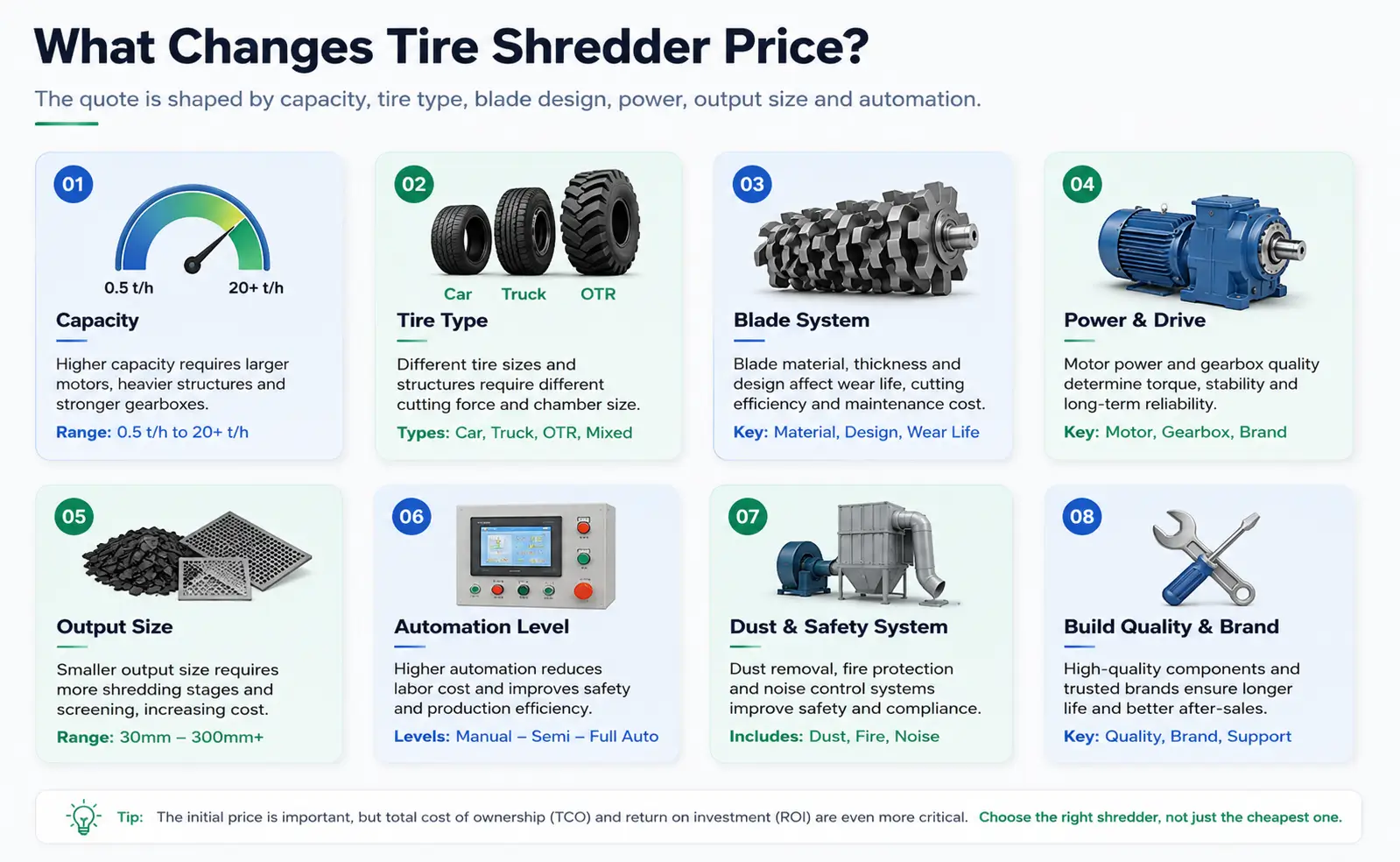
Capacity
Capacity is the most obvious factor. A machine designed for 0.5–2 tons per hour is very different from a heavy-duty system designed for 10 tons per hour or more. Higher capacity usually requires larger shafts, stronger frames, more powerful motors, heavier gearboxes, larger cutters, better feeding systems and stronger discharge handling.
Tire type and tire diameter
Passenger tires, truck tires and OTR tires are not the same material challenge. Large tires contain more rubber, stronger steel and greater structural resistance. ShreddingTech states that its waste tire shredder machine can directly crush steel wire tires with a diameter below 4,000 mm, and its product page lists feeding size of 100–2,600 mm or customized, discharging size of 50–100 mm and production capacity of 0.4–60 t/h. Source: ShreddingTech Waste Tire Shredder Machine
Blade material and design
Blade design is one of the most important price factors and one of the most ignored by first-time buyers. Tire shredding is abrasive. Rubber, steel wire and heat generated during cutting all affect blade wear. Better blade material, heat treatment, cutting geometry and replaceable design can increase the purchase price but reduce long-term downtime and maintenance cost.
Motor and gearbox
Tire shredding requires torque more than speed. A strong motor and reliable gearbox help the machine maintain stable cutting force when processing tough tires. If the drive system is weak, the machine may jam, overload or fail under real operating conditions. This is why two shredders with similar external appearance can have very different prices.
Output size
Output size affects price because smaller and more uniform output requires more cutting control or additional stages. If the goal is only volume reduction, a primary shredder may be enough. If the goal is rubber granules or fine powder, the shredder must feed a downstream system reliably and may need to be paired with a granulator, magnetic separator and fiber separator.
Automation and safety
Automation can include PLC control, automatic feeding, conveyors, reverse protection, overload control, emergency stop systems and integration with downstream equipment. Higher automation increases the initial price, but can reduce labor, improve safety and stabilize daily output.
5. Operating cost vs machine price
Many buyers ask for the lowest machine price. Experienced buyers ask for the lowest total operating cost. The difference is important because tire shredders work under heavy load. A low-cost machine can become expensive if it consumes too much power, needs frequent blade replacement or causes production stoppages.
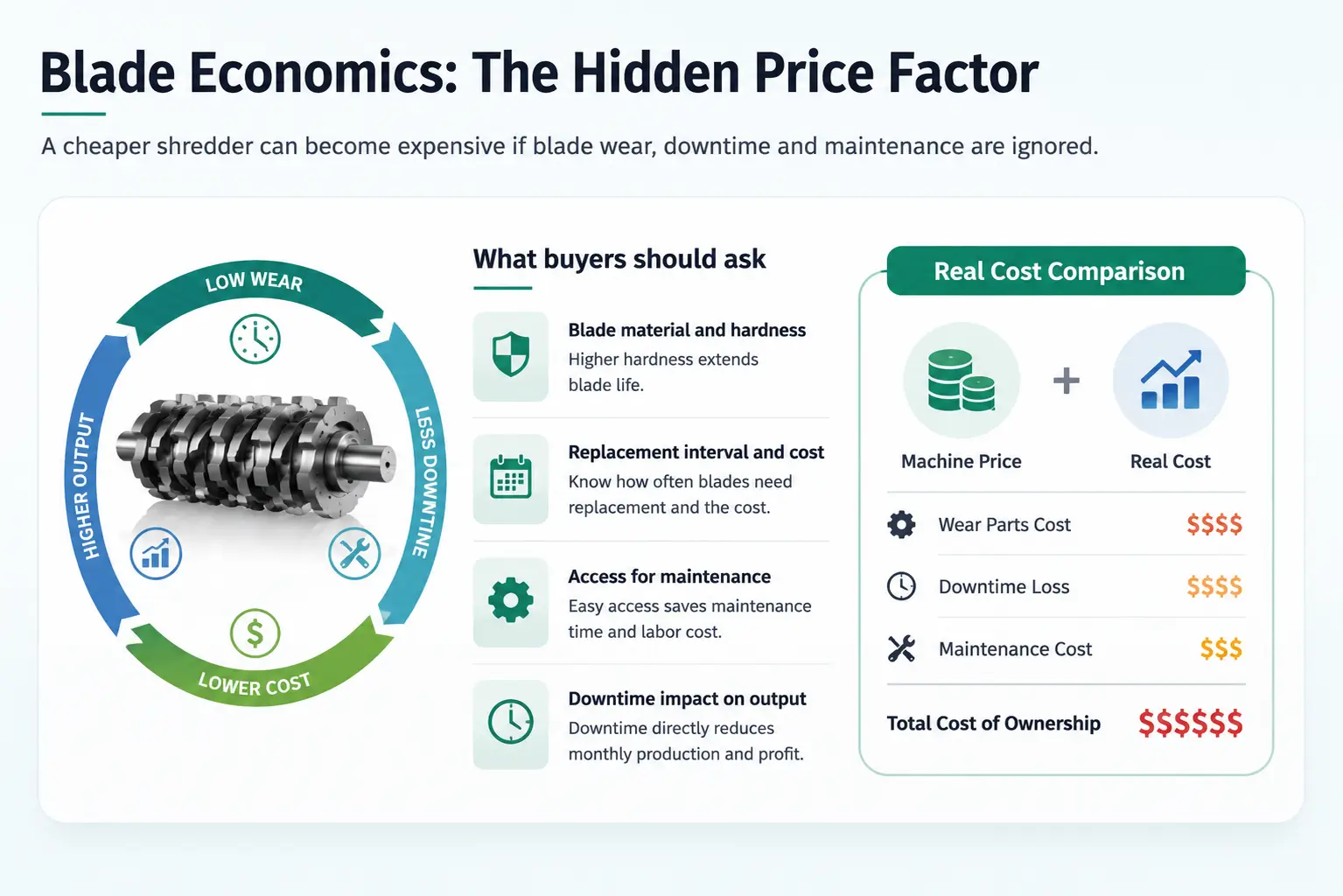
| Cost factor | Long-term impact | Buyer question |
| Electricity | High | What is the total installed power and real production power consumption? |
| Blade wear | High | How long do blades last under similar tire conditions? |
| Downtime | Critical | How easy is maintenance and how quickly can wear parts be replaced? |
| Labor | Medium to high | Does the system require constant manual feeding or sorting? |
| Maintenance | High | Are spare parts available and is the machine designed for service access? |
This is why a price-focused article must include operating economics. The machine price is paid once. Downtime, labor, electricity and wear parts are paid again and again.
6. Cheap tire shredder vs industrial tire shredder
There is a market for low-cost machines, but buyers should understand the trade-off. A cheap tire shredder may be acceptable for occasional use, low volume or simple size reduction. It may not be the right choice for a commercial recycling plant that needs stable output every day.
| Cheap tire shredder | Industrial tire shredder |
| Lower initial price | Higher initial investment but stronger long-term economics |
| May have shorter blade life | Designed for better cutter durability and maintenance access |
| Lower throughput or unstable output | Higher throughput and more consistent shredding performance |
| Limited automation | Can integrate with conveyors, PLC and downstream recycling equipment |
| Suitable for small or occasional use | Better for commercial recycling and continuous operation |
The decision should be based on business purpose. If the buyer only needs to reduce tire volume occasionally, a smaller machine may be enough. If the buyer wants to build a tire recycling business, the shredder must be selected as part of the full process, not as an isolated machine.
7. Real ROI logic: how a tire shredder supports profit
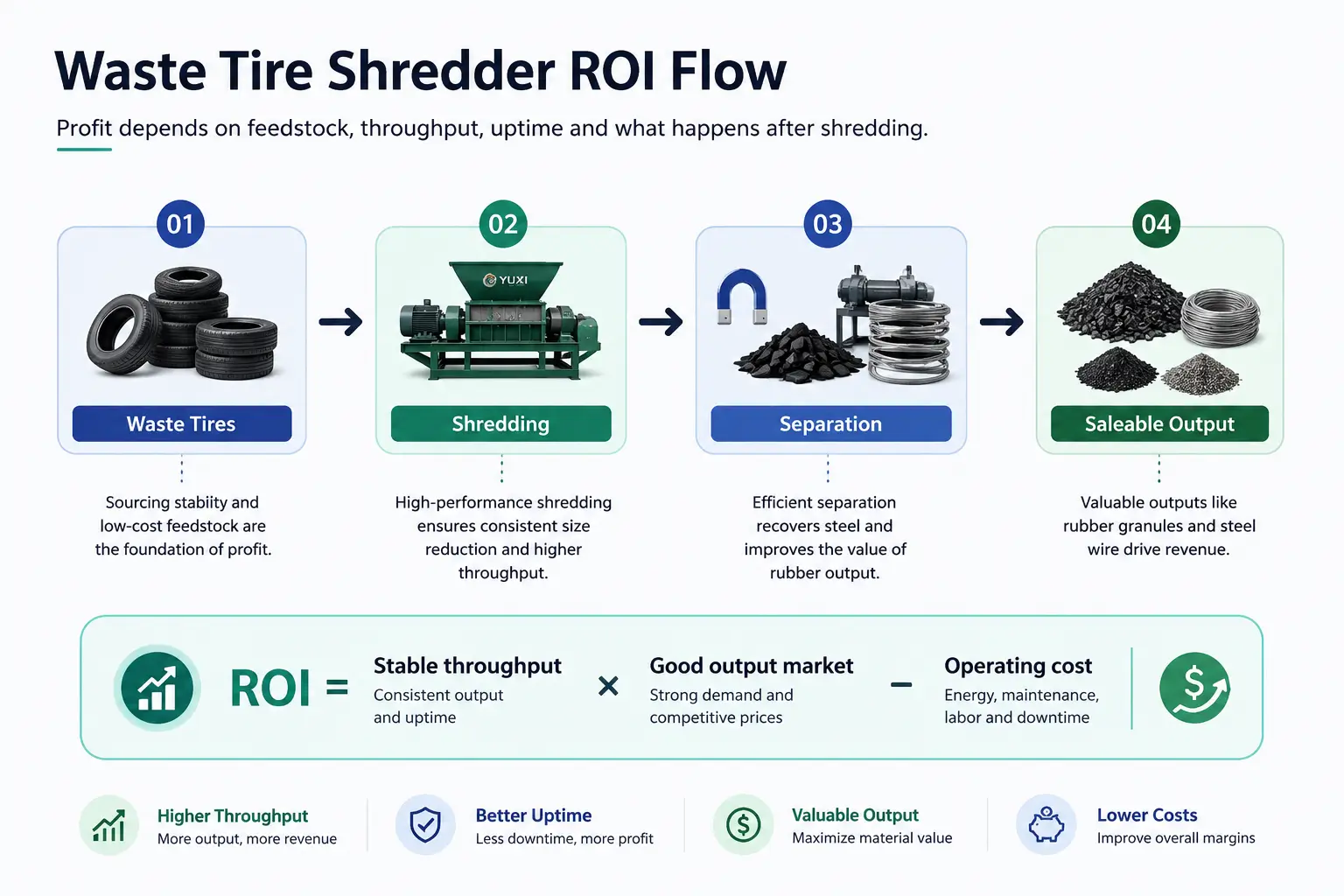
A waste tire shredder does not create profit by itself. It creates profit when it supports a complete business model. That model may include tire-derived fuel, tire-derived aggregate, rubber granules, rubber powder or steel recovery.
USTMA reported that in 2023, 79% of end-of-life tires in the U.S. were reclaimed or recycled, up from 71% in 2021. This shows that tire recycling markets are active, but also that end markets matter. Source: USTMA 2023 End-of-Life Tire Management Report
Here is a simplified example for a 5 t/h commercial setup:
| Item | Example assumption |
| Processing capacity | 5 tons per hour |
| Working time | 8 hours per day, 22 days per month |
| Monthly input | About 880 tons per month |
| Revenue sources | Rubber output, steel wire recovery, possible TDF or downstream material sales |
| Major costs | Feedstock, electricity, labor, blade wear, maintenance and logistics |
The payback period can vary widely. A stable plant with low tire collection cost, strong output buyers and reliable equipment may recover investment much faster than a plant with unstable feedstock, weak buyers or frequent downtime. In many commercial discussions, a realistic payback range may be 6–18 months, but the exact number must be calculated from local conditions.
8. Waste tire shredder applications
A tire shredder can support several tire recycling business models:
Tire-derived fuel preprocessing: shredded tires can be used as fuel in certain industrial markets, depending on local rules and buyer requirements.
Civil engineering applications: tire shreds can be used in applications such as lightweight fill, drainage layers and other engineering uses. EPA notes scrap tire shreds can replace certain construction materials in civil engineering applications. Source: U.S. EPA Civil Engineering Applications
Rubber granule production: shredding prepares the material for granulation, magnetic separation and fiber separation.
Pyrolysis preprocessing: some pyrolysis systems require tires to be shredded before feeding.
Volume reduction: shredding reduces storage and transport volume for waste management operations.
Grand View Research estimates the global tire recycling market at USD 6.87 billion in 2024 and projects it to reach USD 8.46 billion by 2030, with applications including construction, asphalt modification, automotive components and sports surfaces. Source: Grand View Research Tire Recycling Market Report
9. Why Yuxi ShreddingTech tire shredders fit recycling projects
ShreddingTech / Yuxi should not be positioned only as a machine seller. The stronger positioning is a tire recycling solution provider. The website includes both the Waste Tire Shredder Machine for primary size reduction and the Full-automatic Waste Tire Recycling Line for complete rubber, steel wire and nylon fiber separation.
The full-automatic waste tire recycling line page lists production capacity of 200–10,000 kg/h, suitable tire diameter of 400–4,000 mm, discharging size of 140 mesh–100 mm with customization available, automatic separation of rubber, wire and nylon fiber, and PLC control for easier operation and maintenance. Source: ShreddingTech Full-automatic Waste Tire Recycling Line
This matters because some buyers need a shredder, while others need a full business-ready line. A shredder may reduce tire size. A full recycling line can create cleaner material streams and support higher-value output. Related equipment such as the Tire Steel Wire Drawing Machine and Waste Tire Granulator can help buyers build a more complete process.
10. Buyer checklist before buying a waste tire shredder
Before requesting a quotation, prepare the following information. This helps the supplier recommend the correct model and avoids a misleading low-price quote.
Tire type: passenger, truck, agricultural, OTR or mixed tires
Maximum tire diameter and steel content
Expected hourly capacity
Target output size after shredding
Downstream process: TDF, TDA, granules, powder or pyrolysis
Local electricity cost and voltage standard
Labor plan and feeding method
Available factory space and layout
Required automation level
Budget range and expected ROI
Future expansion plan
11. FAQ
How much does a waste tire shredder machine cost?
A small waste tire shredder may cost around US$8,000 to US$40,000. A medium industrial tire shredder may cost US$40,000 to US$120,000. Heavy-duty shredding systems can exceed US$120,000 to US$500,000 depending on capacity, blade design, automation and integration requirements.
What affects tire shredder price most?
The biggest factors are capacity, tire diameter, tire type, blade material, motor and gearbox strength, output size, automation, safety features and whether the machine is part of a complete recycling line.
Is a double shaft shredder better for waste tires?
Double shaft shredders are commonly used for tire shredding because they provide high torque and strong cutting force. However, the best choice depends on tire type, required output and downstream process.
How long do tire shredder blades last?
Blade life depends on tire type, steel content, blade material, heat treatment, maintenance and operating conditions. Buyers should ask suppliers for blade replacement intervals based on similar real applications.
What is the difference between shredding and granulating?
Shredding reduces whole tires into larger pieces or chips. Granulating further reduces rubber material into smaller particles and is usually combined with steel and fiber separation for cleaner recycled rubber output.
What equipment is needed after shredding?
Depending on the final product, the system may need a granulator, magnetic separator, fiber separator, vibrating screen, dust collection system, conveyors and PLC control.
Conclusion: the best tire shredder is not simply the cheapest one
Waste tire shredder machine price should be evaluated through the lens of long-term business performance. The best machine is not always the lowest quote. It is the machine that matches your tire type, capacity, output target, operating cost and downstream recycling plan.
If your goal is only volume reduction, a smaller shredder may be enough. If your goal is a profitable tire recycling business, the shredder should be selected as part of a complete system. That system must consider rubber output, steel recovery, fiber separation, energy cost, blade wear, uptime and buyer markets.
Get a custom waste tire shredder solution
Recommended CTA: Send your tire type, required capacity, target output size and business goal to Yuxi / ShreddingTech engineers. The team can recommend a tire shredder model or complete tire recycling line based on your project conditions.
Contact ShreddingTech / Yuxi for a project quotation

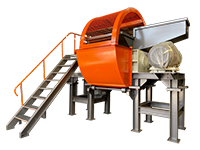 Shredding Machine
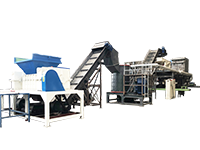 Waste Recycling Line
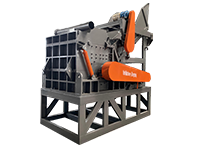 Optional Equipment