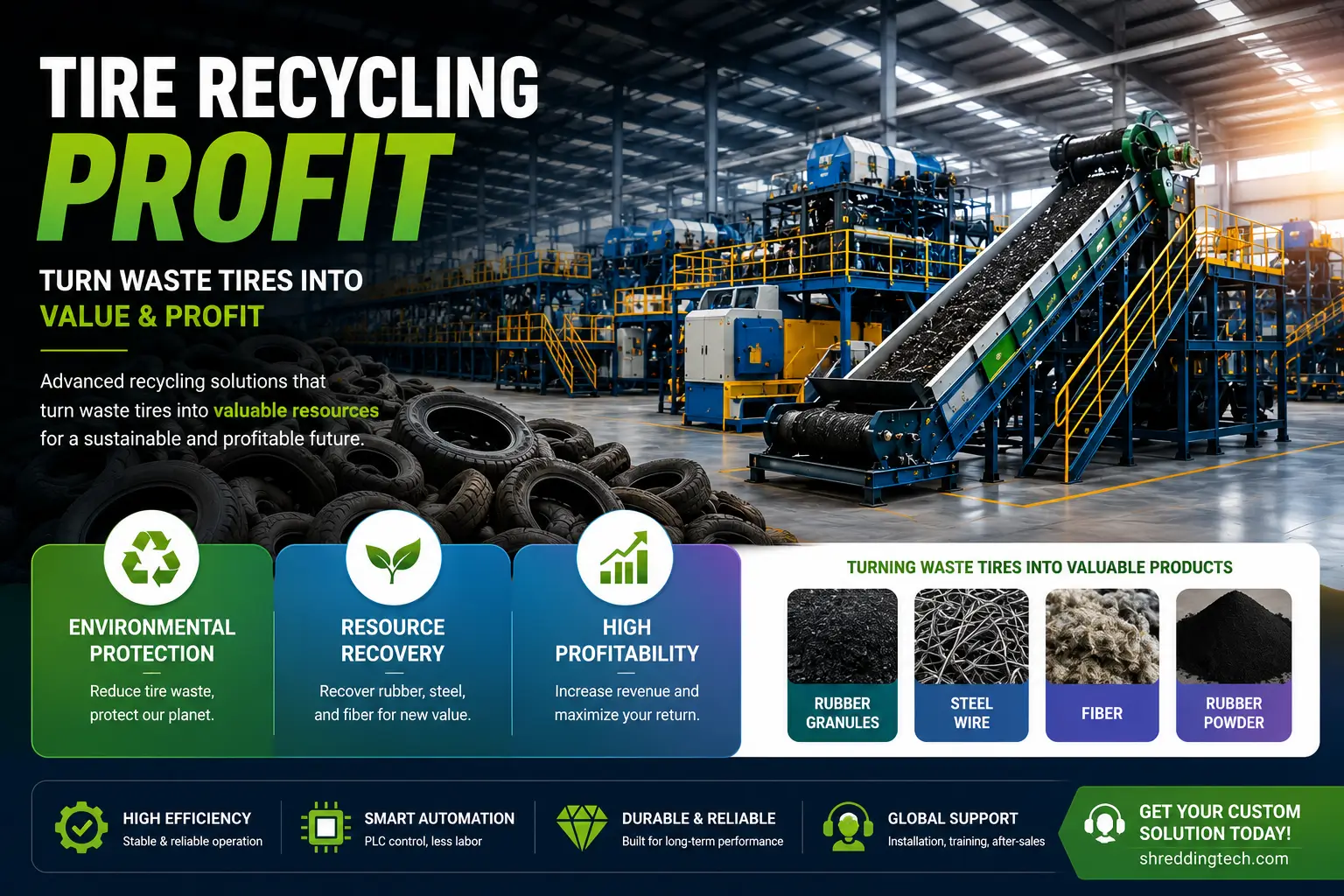
When people search for tire recycling profit, they usually want a simple answer. They want to know whether waste tires can become a profitable business, how much money a plant can make, and how fast the investment can return. The simple answer is yes, tire recycling can be profitable. The better answer is that tire recycling is profitable only when the business is designed as a complete operating system, not as a machine purchase.
This distinction matters. Many articles talk about profit per ton, rubber prices, steel recovery, and ROI. Those points are useful, but they do not explain why two tire recycling plants with similar equipment can produce very different financial results. One plant may run smoothly, sell clean rubber granules, recover steel efficiently, and keep logistics under control. Another plant may have the same theoretical capacity but lose money because raw material is expensive, output quality is inconsistent, transport cost is too high, or the machines stop too often.
The real question is not simply is tire recycling profitable. The real question is under what conditions does tire recycling become profitable. This guide answers that question from the perspective of a buyer, investor, or recycling company evaluating a real project. It combines industry benchmarks, operating logic, risk analysis, and Yuxi or ShreddingTech related solution thinking into one practical article.
1. The real profit structure of tire recycling
Most basic guides describe tire recycling profit as revenue minus cost. That is technically correct, but it is too simple to guide an investment decision. In practice, tire recycling profit comes from three layers.
Material value: the value of rubber, steel wire, and other separated materials.
Processing efficiency: how much material the plant can process with reasonable labor, energy, and downtime.
Market access: whether the final product can be sold consistently at a good price.
If one of these layers is weak, profit drops quickly. A plant may recover valuable material but fail because energy cost is too high. It may have good capacity but fail because the rubber output is not clean enough for better buyers. It may have a strong machine line but fail because tire collection costs were underestimated.
This is the first point many competing articles miss. Tire recycling is not just a volume business. It is a margin business. The goal is not only to process more tires. The goal is to produce saleable material at a controlled cost with stable operation.
2. How tire recycling businesses make money
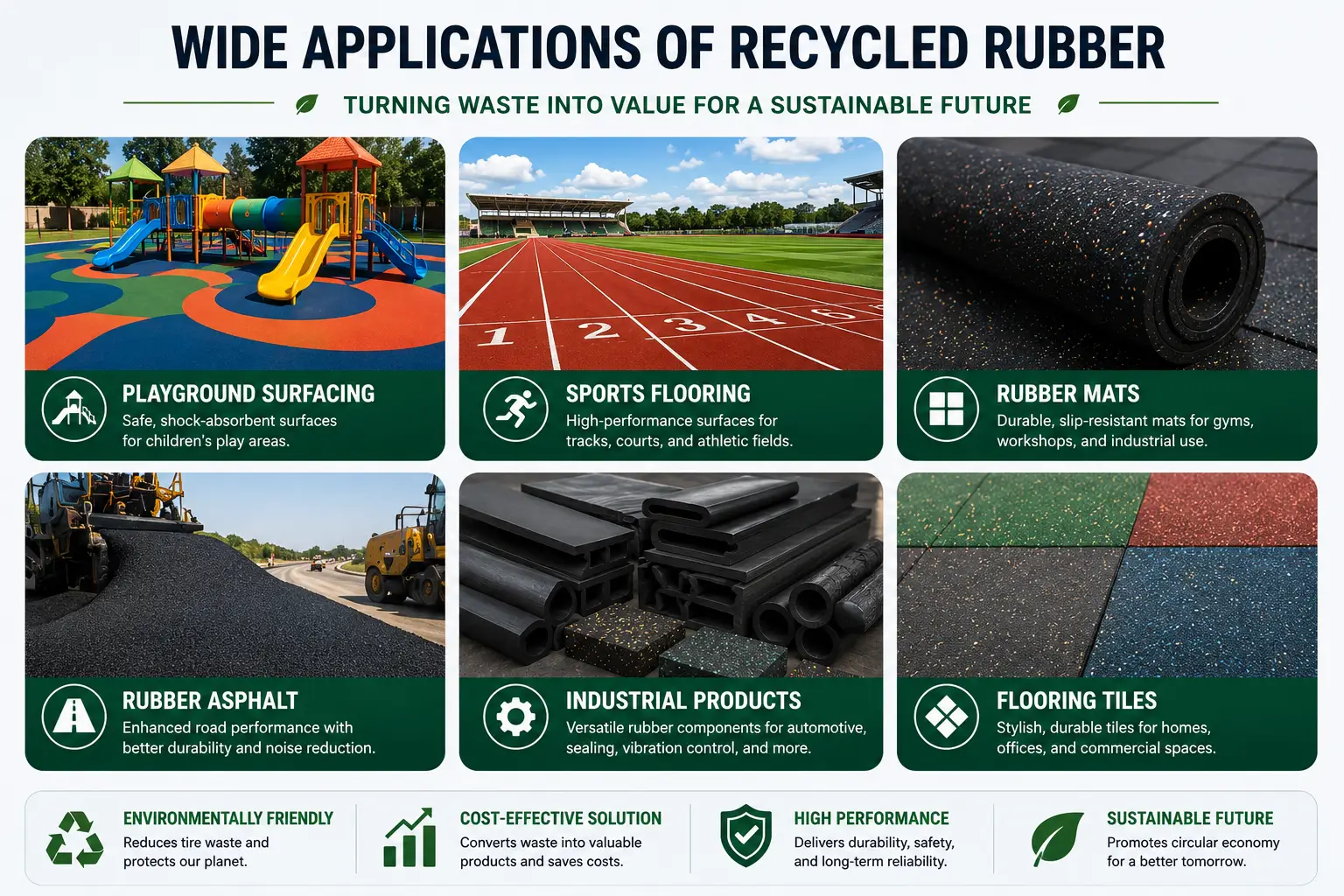
A tire recycling business may earn revenue from several channels. The exact revenue mix depends on the country, local regulations, product quality, and whether the company only shreds tires or produces higher-value outputs.
Rubber chips, granules, and crumb rubber
The main revenue source is usually recycled rubber. Coarse tire chips may be sold for lower-value uses. Rubber granules and crumb rubber can be used in playground surfaces, sports fields, modified asphalt, molded rubber products, mats, construction materials, and other applications. The more consistent and cleaner the rubber output, the easier it is to reach higher-value buyers.
Industry guides often mention crumb rubber values ranging widely depending on region and product grade. The key point is not one fixed price. The key point is that output quality strongly affects market price. A plant that produces contaminated or inconsistent material will not command the same price as a plant that produces cleaner, better-sized rubber particles.
Steel wire recovery
Steel wire is another important revenue stream. Tires contain steel, and recovering that steel efficiently improves the economics of the plant. If the separation process is poor, steel can remain in the rubber output, reducing product quality. If steel recovery is efficient, the business gains an additional saleable stream and improves the quality of the rubber product.
Collection or disposal fees
In some markets, tire recyclers may also receive collection fees, disposal fees, or government-supported handling fees, and some business models include collection-related revenue, and transport route optimization can strongly affect margins.
This is a major difference between regions. In one country, waste tires may be a paid feedstock. In another country, companies may pay recyclers to take tires away. This is why a profit model copied from another market can be misleading.
3. Realistic profit benchmarks
Profit numbers vary, but industry reports provide useful benchmarks. IMARC Group states that waste tyre recycling projects can show gross margins around 35 to 45 percent and net profit around 15 to 20 percent under normal operating conditions. IMARC also identifies raw materials and utilities as major operating cost categories. Source: IMARC Group, Waste Tyre Recycling Plant Project Report 2026
Long-term financial analysis and comparison show that a well-managed tire recycling business can achieve an operating profit margin of 8% to 25%; and through systematic efficiency optimization, companies with outstanding operational performance can even reach the upper limit of this range.
These two sources are not necessarily contradictory. They are looking at profit from different business assumptions and operating contexts. The useful lesson is that real-world profit is not one universal number. It depends on plant design, utilization, feedstock cost, labor, energy, market access, and equipment reliability.
| Profit factor | Good condition | Weak condition |
| Raw material supply | Stable tires at low or controlled cost | Unstable supply or high tire purchase cost |
| Output product | Clean rubber granules or powder with buyers | Low-value mixed material with weak demand |
| Plant operation | Stable throughput and predictable maintenance | Frequent downtime and inconsistent output |
| Logistics | Short collection radius and efficient transport | Long-distance tire movement and high storage cost |
4. The hidden economics most articles do not explain
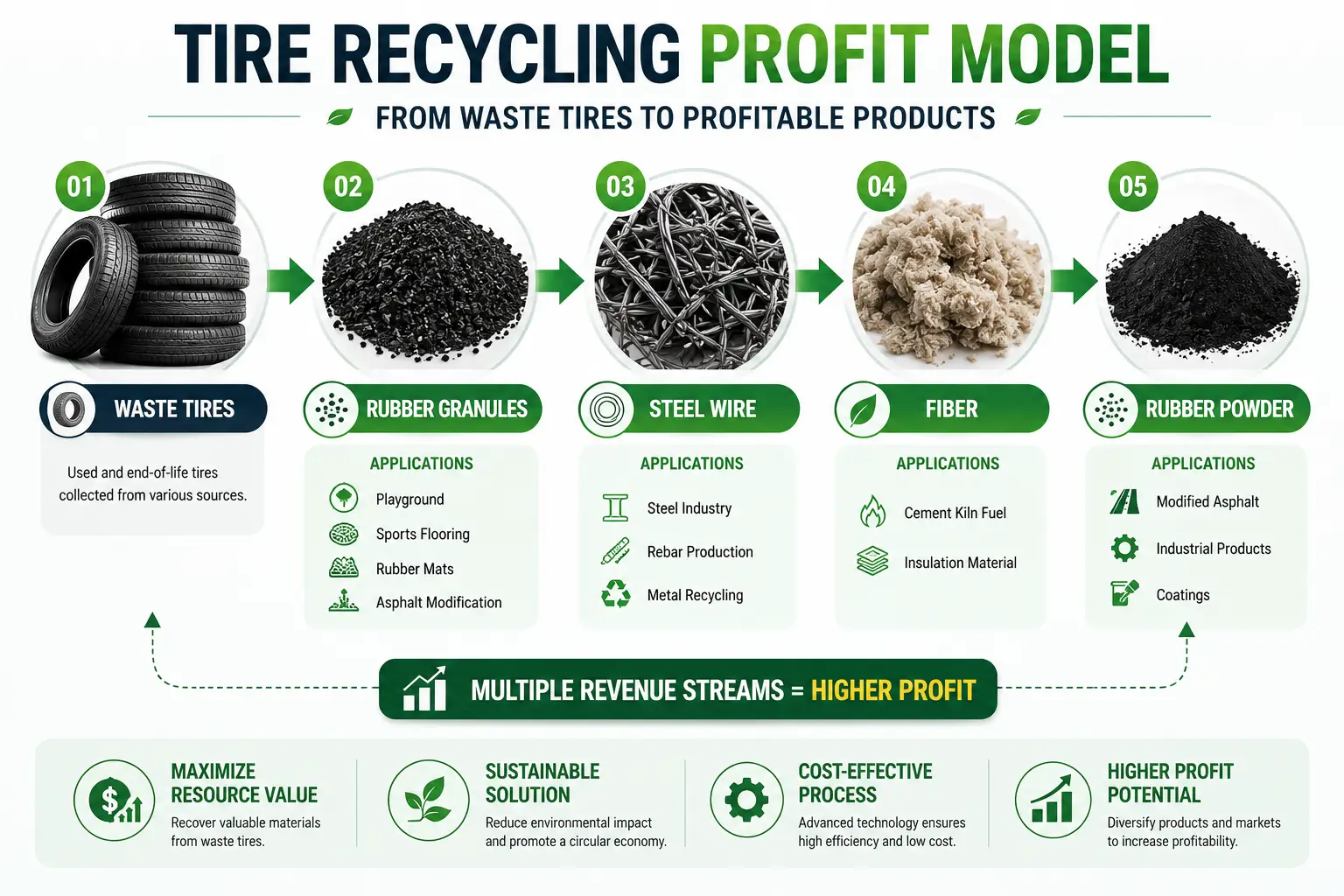
This section is where investors should pay close attention. Many online articles focus heavily on sales potential, but the real profit is often decided by hidden cost control.
Raw material cost is not just a line item
Raw material cost can be the largest operating variable. IMARC states that raw materials may account for approximately 30 to 40 percent of operating expenses in a waste tyre recycling plant. Source: IMARC Group
If tires are available for free or at low cost, the plant has a strong starting advantage. If tires must be purchased at a high price, the margin becomes much thinner. If supply is unstable, the plant may operate below capacity, which damages ROI even if the machine line itself is good.
The best operators do not start by asking only for equipment price. They first ask whether they can secure tires consistently. If the answer is unclear, the investment model is not ready.
Logistics is the silent margin killer
Tires are bulky. They take up space, reduce transport efficiency, and require storage planning. A plant that looks profitable on paper can become weak if tires must be collected from too far away. We highlight transportation cost as an important factor in route economics and notes that route optimization can materially improve returns.
This is why local supply density matters. A medium-capacity plant near stable tire sources may outperform a larger plant that must spend too much money collecting material. Bigger is not always better. The correct scale is the scale that matches the local supply radius and sales market.
Energy cost changes the real ROI
Utilities are another major cost category. IMARC notes that utilities may represent around 20 to 25 percent of operating expenses for waste tyre recycling projects. Source: IMARC Group
This matters because many tire recycling lines involve shredding, granulating, conveying, separation, dust control, and sometimes fine grinding. The total energy cost is not only the motor power of one machine. It is the line-level consumption during real production.
Downtime is more expensive than many buyers think
Cheap equipment can look attractive at the quotation stage. But if it stops often, requires frequent blade replacement, produces inconsistent output, or needs too much manual correction, the real cost becomes high. Downtime reduces throughput, delays orders, increases labor pressure, and weakens buyer confidence.
This is one reason equipment stability has a direct link to profit. A machine that is slightly more expensive but runs more reliably may be the cheaper choice over the life of the project.
5. Why some tire recycling businesses fail
Tire recycling businesses usually do not fail because rubber has no value. They fail because the project was planned incorrectly. The most common failure patterns are easy to identify.
No stable tire supply: the plant cannot run at planned capacity.
No confirmed buyers: the plant produces material but cannot sell it at expected prices.
Wrong equipment configuration: the line cannot produce the target output quality.
Underestimated logistics: collection and transport costs consume the margin.
Poor maintenance planning: downtime becomes normal instead of exceptional.
We know that profitability depends on end product, scale, and operational efficiency.
The important lesson is that many failures happen before the plant is built. If the business model is weak, even good equipment cannot fully save the project. If the business model is strong, the correct equipment and layout can amplify the profit.
6. Profit by business model
Not all tire recycling businesses operate the same way. The profit potential changes depending on how deep the processing goes.
| Business model | Typical output | Profit potential | Main challenge |
| Basic shredding | Tire chips or rough shreds | Lower to medium | Lower product value and stronger price competition |
| Granule production | Rubber granules plus recovered steel | Medium to strong | Requires better separation and consistent sizing |
| Fine powder production | Fine rubber powder for higher-value uses | Potentially higher | Higher equipment demand, energy use, and quality control |
| Integrated recycling model | Multiple rubber products and steel recovery | Strong when well managed | Requires market development and stronger operations |
The deeper the processing, the higher the possible value. But higher processing depth also means greater technical demand and more operating complexity. This is why the best model is not always the most advanced model. The best model is the one that matches local market demand.
7. Yuxi or ShreddingTech solution logic: profit comes from the system
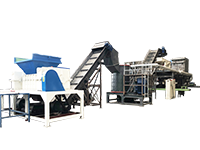
Yuxi or ShreddingTech should not be positioned only as a machine supplier in this article. The stronger positioning is system-based profit improvement. On the Yuxi ShreddingTech website, the full-automatic waste tire recycling line is described with a production capacity of 200 to 10,000 kg per hour, suitable tire diameter of 400 to 4,000 mm, PLC control, and separation of rubber, steel wire, and nylon fiber. Source: ShreddingTech, Full-automatic Waste Tire Recycling Line
This information is useful because it connects equipment features to profit logic. PLC control matters because stable control helps reduce operation difficulty. Multi-material separation matters because rubber, steel, and fiber need to be handled differently. Custom design matters because plant layout affects labor, transport, and daily efficiency.
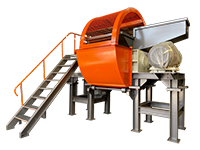
Yuxi also offers waste tire shredder equipment for size reduction, with the site describing feeding size, output size, production capacity, and support for customization and site design. Source: ShreddingTech, Waste Tire Shredder Machine
For a buyer, the important point is not only the specification. The important point is how those specifications support a business target. If the target is rubber granules, the line must be designed for that output. If the target is tire-derived fuel, the requirements may be different. If the target is fine rubber powder, grinding and separation become more important.
8. The decision framework investors should use
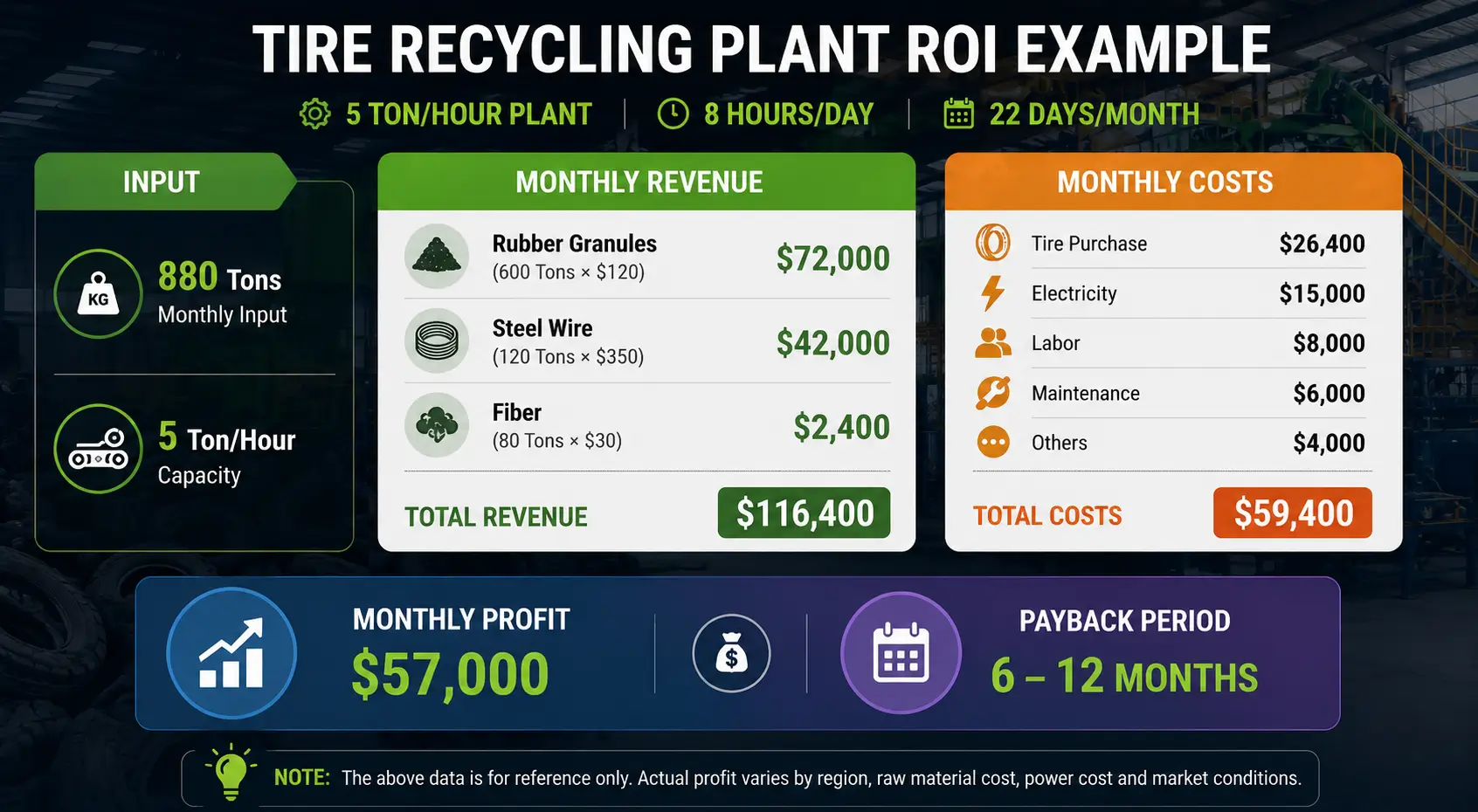
Before investing in a tire recycling plant, use this decision framework. It is simple, but it prevents many expensive mistakes.
Question 1: Can you secure enough tires?
If the answer is no, stop. Tire supply comes before equipment purchase. A plant that cannot run near planned capacity will struggle to recover investment.
Question 2: Do you know who will buy the output?
If the answer is no, stop. Production does not create profit by itself. Profit comes when the output is sold at a margin. Before choosing fine powder, granules, or chips, confirm the local buyers and their quality requirements.
Question 3: Can you control logistics and energy cost?
If the answer is uncertain, calculate again. Logistics and utilities can quietly destroy the business model. A realistic ROI model should include collection radius, truck loading, storage area, power price, labor, and maintenance.
Question 4: Is the plant configuration matched to your market?
If the answer is unclear, redesign. A cheap system that cannot produce the right output is not a bargain. A highly advanced system that produces material nobody buys is also not a good investment. Market fit comes first.
9. A more realistic ROI view
Many promotional pages talk about fast ROI. Fast ROI is possible in strong conditions, but it should not be presented as automatic. The report pointed out that overall business ROI often depends on market penetration, customer relationships, and operational efficiency, with business ROI timelines varying by operation.
A realistic ROI view should include three scenarios.
| Scenario | Condition | Likely result |
| Weak project | Unstable feedstock, unclear buyers, poor layout | Long payback or negative profit |
| Normal project | Acceptable tire supply, normal buyers, reasonable equipment | Gradual ROI with moderate margins |
| Optimized project | Stable supply, clear market, efficient line, good layout | Stronger cash flow and faster payback |
This approach is more useful than promising one fixed payback period. It helps the buyer understand what must be true for the profit model to work.
10. Market outlook: why tire recycling still has long-term potential
Tire recycling is supported by several long-term drivers: environmental regulation, landfill restrictions, demand for recycled materials, infrastructure projects, and circular economy policies. These factors do not remove business risk, but they do support the long-term need for tire recycling capacity.
Fortune Business Insights reports that the tire recycling market is expected to grow over the coming years, driven by environmental awareness, regulatory pressure, and expanding applications for recycled tire materials. Source: Fortune Business Insights, Tire Recycling Market
The market trend is positive, but investors should still avoid lazy thinking. A growing market does not guarantee that every plant will profit. The winners will be operators who secure supply, control cost, produce consistent output, and build real sales channels.
11. Practical profit checklist
Use this checklist before requesting a final quotation.
Feedstock: confirm monthly tire volume, source location, tire type, and purchase or collection cost.
Output: decide whether the target product is chips, granules, crumb rubber, fine powder, steel, or a combination.
Buyers: confirm who buys the output, what quality they require, and what price they can pay.
Utilities: calculate electricity price, total line power demand, and daily operating hours.
Labor: estimate required operators, maintenance staff, loading staff, and management.
Layout: plan tire receiving, storage, feeding, processing, output storage, dust control, and truck movement.
Maintenance: understand blade life, spare parts, service access, and downtime risk.
Expansion: decide whether the line should allow future capacity upgrades.
12. Final conclusion: tire recycling profit is designed, not guessed
Tire recycling can be a profitable business, but profit does not come from buying a machine and waiting for money to appear. Profit is designed through supply control, output strategy, equipment selection, layout planning, cost management, and market development.
The most important idea is simple. Tire recycling is not just a machine business. It is a system-driven industrial business. The companies that treat it as a system have a much better chance of building stable profit. The companies that focus only on the lowest equipment price usually take more risk than they realize.
For buyers evaluating a project, the best next step is to create a realistic profit model before choosing the final plant configuration. That model should include tire supply, product buyers, output size, operating cost, automation level, and expected maintenance. Only then does the equipment quotation become meaningful.
Yuxi or ShreddingTech can be positioned as a solution partner for this stage: not just offering a tire shredder, but helping match the recycling line to the customer’s raw material, target output, plant layout, and profit goal.
Call to action: If you are planning a tire recycling business, request a tire recycling profit analysis before buying equipment. A useful analysis should include feedstock assumptions, output strategy, equipment configuration, layout advice, and ROI estimation.
FAQ
Is tire recycling profitable?
Yes, tire recycling can be profitable when tire supply is stable, operating costs are controlled, and the final products have confirmed buyers. Profit is not automatic. It depends on the business model and plant design.
What is the typical profit margin in tire recycling?
Industry sources show different ranges depending on assumptions. IMARC reports gross margins around 35 to 45 percent and net profit around 15 to 20 percent for waste tyre recycling projects. Gradeall states that well-managed operations may achieve operating profit margins of 9 to 25 percent. These numbers should be treated as benchmarks, not guarantees.
What is the biggest risk in tire recycling?
The biggest risks are unstable tire supply, high logistics cost, unclear output buyers, poor equipment configuration, and downtime. Raw material and logistics are especially important because they can reduce margins before production even begins.
What equipment is needed for a profitable tire recycling line?
A typical line may include tire pre-treatment, tire shredding, granulation, magnetic separation, fiber separation, dust control, conveyors, and a PLC control system. The exact configuration depends on whether the target output is tire chips, rubber granules, crumb rubber, fine powder, steel, or multiple products.
Why does Yuxi ShreddingTech fit this topic?
Yuxi ShreddingTech provides tire shredding equipment and full-automatic waste tire recycling line solutions. Its website describes capacity ranges, suitable tire sizes, PLC control, and rubber, steel, and fiber separation. These points are relevant because tire recycling profit depends on system efficiency, output quality, and stable operation.

 Shredding Machine
 Waste Recycling Line
 Optional Equipment