A waste tire recycling line is not simply a tire shredder. It is a complete production system that decides whether scrap tires become low-value waste, rough tire chips, clean rubber granules, steel wire, fiber, or higher-value downstream materials. For buyers comparing recycling equipment, this distinction is critical. A cheap machine can reduce tire size, but a well-designed line controls material flow, separates valuable outputs, reduces labor dependence, improves product quality and creates a more stable business model.
This guide is written for buyers, recycling investors, waste management companies and industrial operators evaluating the Yuxi / ShreddingTech Full-Automatic Waste Tire Recycling Line. Instead of repeating a simple product introduction, it explains the product through market demand, process design, equipment selection, cost control, output applications and buyer decision logic. The goal is to answer the questions serious buyers actually ask before investing.
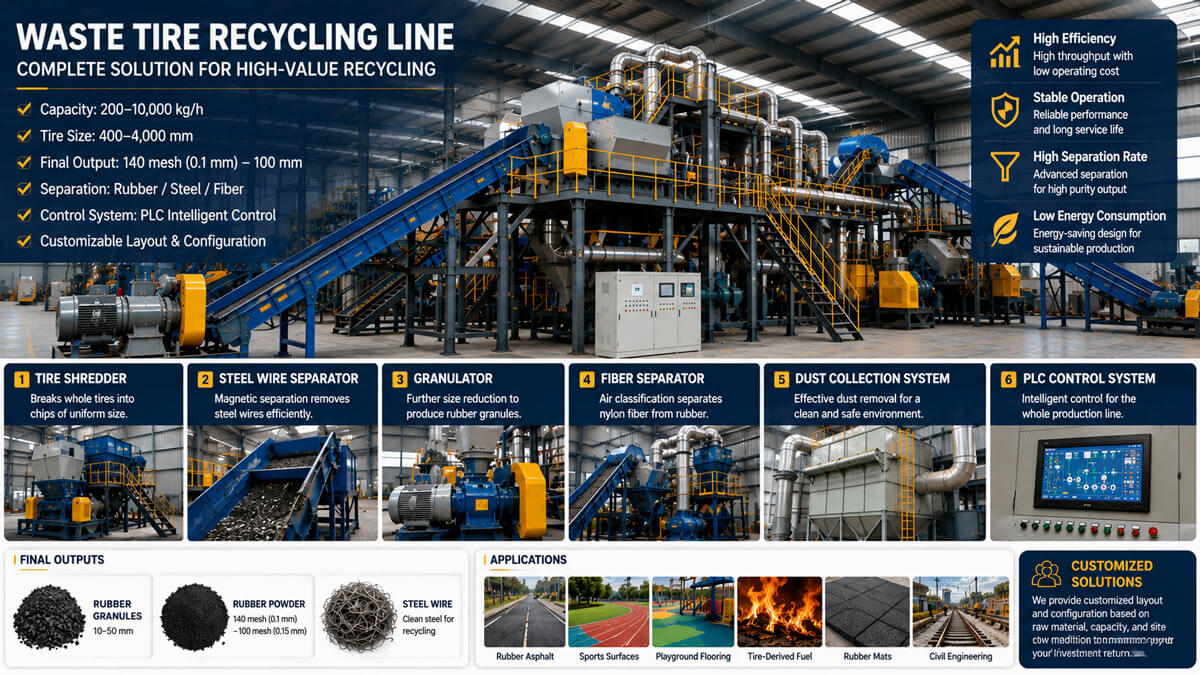
The Yuxi product page states that this full-automatic waste tire recycling line is designed for a production capacity of 200 to 10,000 kg/h, suitable tire diameter of 400 to 4,000 mm, and discharging size from 140 mesh to 100 mm with customization available. The same page says the line can automatically separate rubber, steel wire, nylon fiber and other materials, and uses a PLC control system for easier operation and maintenance. Source: ShreddingTech product page
1. Why waste tire recycling is a system opportunity, not just a machine opportunity
Scrap tires are difficult to handle because they are bulky, elastic, mixed-material products. A tire contains rubber, steel wire, textile fiber and additives. If the recycling process only cuts or shreds the tire, the output may still be difficult to sell at a good price. The real value appears when the line can reduce tire size and separate the main material streams in a controlled way.
The U.S. EPA identifies the largest scrap tire markets as tire-derived fuel, civil engineering applications and ground rubber applications including rubberized asphalt. Other uses include whole or cut tire products, retreading and pyrolysis. Source: U.S. EPA, Scrap Tire Markets/Uses
This matters for equipment selection. If the target market is rough tire-derived aggregate, the line may focus on size reduction and durability. If the target is rubber granules or powder, separation quality becomes much more important. If the target is rubberized asphalt or molded rubber products, output consistency and contamination control become business-critical.
2. What makes the Yuxi full-automatic waste tire recycling line different
Many tire recycling pages only describe capacity. Capacity is important, but capacity alone does not build a profitable recycling business. The stronger value of this Yuxi product is that it is presented as a complete processing line with multiple stages: wire drawing, shredding, wire separation, vibrating screening, magnetic separation, rubber pelletizing and fiber separation. This makes the page more suitable for commercial buyers who need an end-to-end solution rather than a single machine.
| Yuxi product point | Why it matters to the buyer |
| 200 to 10,000 kg/h capacity range | Allows both smaller commercial plants and larger recycling operations to choose a configuration closer to their real feedstock volume. |
| Suitable tire diameter 400 to 4,000 mm | Supports a wide range of tire types, including larger industrial or engineering tires when properly configured. |
| Output size from 140 mesh to 100 mm | Shows that the line can be configured for different output strategies, from chips and granules to finer rubber powder. |
| PLC control system | Helps reduce operation difficulty, improve process control and make the line easier to operate and maintain. |
| Automatic separation of rubber, wire and nylon fiber | Improves output value because clean material streams are easier to sell and use downstream. |
| Custom site design | Important because plant layout affects logistics, labor cost, safety, dust control and future expansion. |
This is the first “people have it, we have it; people do not have it, we add it” angle: the article should not just say the machine is automatic. It should explain why automation matters economically. Automation is not only about fewer workers. It is about repeatability, safety, output consistency and lower dependence on manual correction.
3. The full process: how whole tires become saleable output

A full waste tire recycling line normally follows a logical sequence. The exact configuration depends on tire size, input condition, target output size and buyer requirements, but the system logic is usually similar.
Pre-treatment and wire drawing: removes or loosens heavy steel wire so the next crushing stage works more smoothly.
Primary shredding: reduces whole tires into smaller rubber blocks or chips.
Rasping or secondary reduction: reduces rubber blocks into smaller particles and begins stronger steel separation.
Screening: separates particles by size and returns oversized particles for further processing.
Magnetic separation: removes remaining steel wires from rubber material.
Fiber separation: removes textile fiber and light impurities from rubber particles.
Fine grinding or pelletizing: produces smaller granules or rubber powder when the market requires higher-value output.
Yuxi’s product page lists a wire drawing machine, waste tyre shredder, wire separator, vibrating screen, magnetic separator, rubber pellet machine and fiber separator as part of the equipment logic. It also states that the rubber pellet machine can crush separated rubber into 1 mm size and that 99% of fibers are removed during the pelletizing process. Source: ShreddingTech product page
4. End-market demand: why output quality matters
A tire recycling line should be designed backward from the market. Before choosing equipment, the buyer should ask what the plant will sell. Different outputs have different buyers, quality requirements and price levels.
EPA states that ground rubber applications and rubberized asphalt are among the major scrap tire markets. EPA also explains that civil engineering applications use scrap tire material as a replacement for other construction materials such as lightweight fill, drainage aggregate, soil or clean fill. Source: U.S. EPA, Scrap Tire Markets Source: U.S. EPA, Civil Engineering Applications
USTMA reports that tire recycling markets consumed approximately 79% of annually generated end-of-life tires in the U.S. in 2023, up from about 71% reported in 2021. USTMA also points to market growth potential in rubber-modified asphalt and tire-derived aggregate. Source: USTMA Tire Recycling Markets
Grand View Research estimates the global tire recycling market at USD 6.87 billion in 2024 and projects it to reach USD 8.46 billion by 2030, with building and construction accounting for the largest application share in 2024. It also notes that recycled rubber is increasingly used in asphalt modification, automotive components and sports surfaces. Source: Grand View Research Tire Recycling Market Report
These sources support an important sales argument for the Yuxi page: the value of the line is not only that it processes tires. The value is that it helps create outputs for markets that already exist: construction, road materials, rubber products, steel recovery and other recycled tire-derived applications.
5. “People have it, we have it”: the information buyers expect
Most product pages in this industry cover a few basic points: capacity, final particle size, equipment list, automation, application and inquiry button. A strong page must include these, because buyers expect them.
Capacity range: buyers need to match equipment to monthly tire supply.
Input size: buyers need to know whether passenger, truck or larger tires are supported.
Output size: buyers need to match output to buyer requirements.
Material separation: buyers need to know whether rubber, steel and fiber can be separated.
Automation level: buyers need to estimate labor and operation difficulty.
Equipment configuration: buyers need to understand the actual processing stages.
Customization: buyers need confidence that the line can fit their site and market.
The Yuxi product page already provides many of these points, including capacity, tire diameter, output size, PLC control, automatic separation and custom site design. The opportunity is to reorganize this information into a buyer-friendly narrative instead of leaving it as scattered product text.
6. “People do not have it, we add it”: the decision content competitors often miss
The deeper content opportunity is buyer decision support. Many competing pages show equipment but do not teach the buyer how to choose the correct line. This is where Yuxi can create stronger E-E-A-T. A useful product page should help buyers avoid mistakes before they request a quote.
Question 1: What tire types will you process?
Passenger tires, truck tires, agricultural tires and large engineering tires are not identical. Tire diameter, steel content, rubber thickness and contamination level all affect equipment selection. Yuxi states that the full-automatic line can be used for tires with diameters from 400 to 4,000 mm, but the final configuration still needs to match the real tire mix.
Question 2: What output will you sell?
If the buyer only needs rough tire chips, the configuration can be simpler. If the buyer wants rubber granules, clean steel and low-fiber rubber particles, the separation system becomes more important. If the buyer wants fine powder, grinding and screening must be planned more carefully.
Question 3: What is the local end market?
A buyer should not choose output size only because it sounds valuable. They should confirm who will buy it. Rubberized asphalt, construction fill, molded rubber products, sports surfaces and crumb rubber buyers may have different requirements. The best recycling line is the one that matches the local buyer’s specification.
Question 4: How much labor and power can the plant support?
Yuxi states that a large 3 ton/hour waste tire recycling plant takes only 4 to 6 people and that a 3 ton/hour rubber particle line has a total installed capacity of about 550 kW. Source: ShreddingTech product page This information is important because labor and power are not minor details. They directly affect operating cost and ROI.
Question 5: Is the plant layout designed for material flow?
Tire recycling is logistics-heavy. Whole tires are bulky, storage takes space, and output material must be collected efficiently. A line can have good machinery but still perform poorly if the site layout is wrong. Yuxi’s custom site design service is therefore a real commercial advantage, not just a service phrase.
7. How to position this product for E-E-A-T
To build E-E-A-T, the page should show experience, expertise, authority and trust through useful evidence. For this product, that means combining Yuxi’s own specifications with external industry references and practical buyer guidance.
| E-E-A-T element | How this page should show it |
| Experience | Explain real buyer decisions: tire type, output market, site size, energy cost, labor and layout. |
| Expertise | Describe each equipment stage and why it affects output quality and value. |
| Authority | Reference EPA, USTMA and market research sources to connect the product to real end markets. |
| Trust | Use verifiable product specifications, transparent assumptions and risk guidance instead of exaggerated profit claims. |
8. Product applications: where the recycled material can go
The most buyer-focused way to describe applications is to connect final output to end use.
Rubber chips: can be used in tire-derived aggregate, civil engineering fill and rough material applications depending on local regulations and buyer requirements.
Rubber granules: can be used for rubber flooring, sports surfaces, playground surfaces, molded rubber products and other rubber goods.
Rubber powder: can be used in rubber-modified asphalt, rubber products, coatings or other downstream applications depending on mesh size and purity.
Recovered steel wire: can be sold as scrap steel when separated cleanly.
Fiber material: may be collected separately and handled according to local recycling or disposal channels.
9. Practical configuration logic for different buyers
| Buyer type | Likely goal | Important configuration focus |
| Waste management company | Reduce tire volume and create recyclable material | Durable shredding, stable feeding, rough output handling and storage efficiency |
| Rubber granule producer | Produce clean granules for downstream buyers | Separation accuracy, screening, magnetic separation and fiber removal |
| Rubber powder investor | Produce finer powder for higher-value markets | Grinding, mesh control, dust collection, purity and power planning |
| Large recycling plant | Process large monthly volume with lower labor dependence | PLC control, continuous operation, layout design, maintenance access and automation |
10. Common mistakes when buying a waste tire recycling line
Buying capacity without confirming tire supply: a large line is not useful if there are not enough tires to keep it running.
Choosing output size without confirming buyers: fine rubber powder may sound valuable, but it only matters if the local market can buy it.
Ignoring steel and fiber separation: poor separation reduces rubber quality and lowers resale value.
Underestimating site layout: bad material flow increases labor, handling time and safety problems.
Comparing only the lowest price: downtime, blade wear, maintenance and output inconsistency can cost more than the initial savings.
Forgetting dust control: fine rubber processing can create dust, so collection and site planning matter.
FAQ
What is a full-automatic waste tire recycling line?
A full-automatic waste tire recycling line is a complete production system that processes scrap tires through pre-treatment, shredding, separation, screening and grinding stages to recover rubber, steel wire and fiber. Compared with a single shredder, it is designed to create cleaner, more saleable output streams.
What capacity does the Yuxi waste tire recycling line support?
The Yuxi / ShreddingTech product page lists a production capacity of 200 to 10,000 kg/h. The correct configuration depends on tire type, target output size, plant layout, labor plan and market demand.
What tire sizes can the line process?
The product page states that the line is suitable for tire diameters from 400 to 4,000 mm. For large tires or mixed tire streams, buyers should confirm the exact pre-treatment and shredding configuration.
What final materials can be recovered?
The line is designed to separate rubber, steel wire, nylon fiber and other materials. Depending on configuration, final rubber output may include tire chips, rubber granules or finer rubber powder.
Why is PLC control important?
PLC control helps make operation more stable and easier to manage. For a commercial plant, this can reduce operation difficulty, improve process coordination and support more consistent production.
What markets use recycled tire material?
EPA identifies tire-derived fuel, civil engineering applications and ground rubber applications including rubberized asphalt as major markets. USTMA and market research sources also identify rubber-modified asphalt, tire-derived aggregate, construction and sports surface applications as important demand areas.

 Shredding Machine
 Waste Recycling Line
 Optional Equipment