Executive Summary
From an engineering standpoint, a waste tire is not "rubbish" but a high-performance composite consisting of vulcanized elastomers, high-tensile carbon steel (bead and belt), and synthetic polymer fibers . Recovering these materials requires a mechanical system capable of overcoming the high elastic deformation of rubber and the tensile strength of steel. The double-shaft shredder (DSS) is the industry standard because it utilizes high-torque, low-velocity shearing to achieve material liberation while minimizing thermodynamic degradation.
1. The Kinematics of the Double-Shaft Shearing Mechanism
In shredding engineering, we distinguish between impact (hammer mills) and shearing (rotary knives). Tires are energy-absorbent; they dissipate impact energy, making high-speed crushers inefficient.
1.1 Differential Rotational Velocity
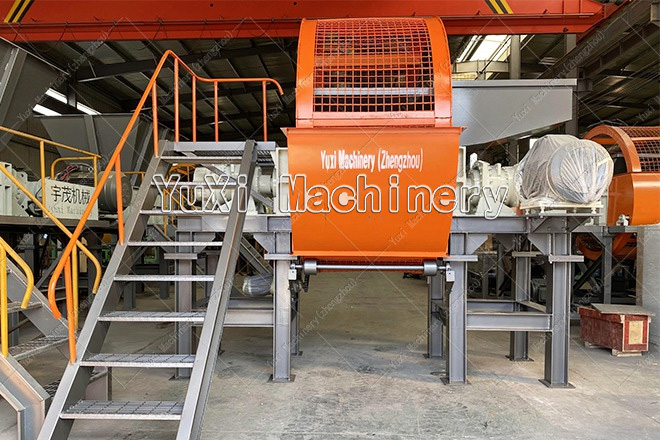
A critical engineering feature of the YXS Series is the independent drive system for each shaft. By utilizing two shafts rotating at slightly different RPMs, we create a differential shearing action. As the "claws" of the blades intermesh, the material is not just cut; it is subjected to multi-directional stress. This ensures that the tire cannot simply "ride" on top of the blades but is pulled into the crushing chamber (the "nip point") via positive displacement.
1.2 Torque Management and Vector Control
The resistance of a truck tire is non-linear. To handle peak loads when the blades encounter the bead wire (the thickest steel component), our engineers utilize high-ratio planetary reducers. These reducers convert the motor's high-speed/low-torque output into the massive rotational force needed to snap 10mm high-carbon steel wire.
PLC Feedback Loops: Sensors monitor the motor current . If exceeds a predefined threshold , indicating a potential jam, the PLC triggers an immediate reversal sequence. This repositioning prevents mechanical fatigue on the shaft and gearbox.
2. Metallurgy and Failure Analysis of Cutting Tools
The most significant Operational Expenditure (OPEX) in tire recycling is tool wear. Engineering the perfect blade is a trade-off between Hardness (HRC) and Impact Toughness.
2.1 Alloy Selection: Beyond the Basics
While many "entry-level" machines use simple carbon steel, professional-grade shredders require specialized tool steels:
H13 (Chromium-Molybdenum Steel): Excellent for its hot-hardness. Even at low speeds, microscopic friction at the cutting edge can reach temperatures that soften lesser steels. H13 maintains its structural edge.
D2/SKD11 (High-Carbon, High-Chrome): Offers superior abrasive wear resistance. However, it is susceptible to "chipping" if the feedstock contains "tramp metal" (non-tire steel).
The Forging Grain Flow: At Yuxi, we employ isostatic forging. Unlike CNC-machined blades from flat stock, forged blades have a grain flow that follows the claw's contour, significantly increasing resistance to "tooth snapping" under peak shear stress.
2.2 Blade Geometry: Claw Configuration
Engineers must select the "claw count" based on the desired TDF (Tire Derived Fuel) size:
1-Claw/2-Claw: Maximum "bite" depth. Ideal for primary shredding of OTR (Off-the-Road) and mining tires.
Multi-Claw (5+): Higher "cuts per revolution," producing a smaller, more uniform chip (e.g., 50mm) in a single pass, but requires higher power ($kW$) per ton of output.
3. Structural Dynamics: Frame Rigidity and Vibration Damping
The forces generated within a shredder are violent. If the machine frame is not sufficiently rigid, the shafts will experience axial and radial deflection.
3.1 Static Mass and Kinetic Stability
The YXS-2600, weighing in at 85 metric tons, is engineered for static stability. Mass acts as a dampener for the kinetic shocks of snapping steel wires.
Frame Construction: We utilize heavy-gauge Q235B or Q345B steel plate, CO2 shielded welding, and most importantly, vibration aging treatment (stress relief) to ensure the frame does not warp over years of high-stress operation.
3.2 External Bearing Housing Design
A common engineering failure in low-quality waste tire shredder is bearing contamination. In our design, the bearing housings are offset from the shredding chamber.
This gap prevents fine rubber dust and pressurized oils from migrating into the roller bearings. We utilize Self-Aligning Roller Bearings to compensate for the micro-deflections of the shaft under maximum load, ensuring the gearbox remains perfectly aligned.
4. Downstream Process Integration: The Full Circular Loop
A primary shredder is only the first stage in a multi-stage liberation process. To achieve a 99.9% purity of rubber, steel, and fiber, we integrate several sub-systems:
4.1 Magnetic Liberation and Cross-Belt Separation
Once the tire is reduced to 50mm chips, the steel belts are "liberated" at the cut edges. We employ Over-band Magnetic Separators with a magnetic flux density of $>2500$ Gauss. This pulls out the high-value scrap steel, which can be sold directly to smelting plants.
4.2 Fiber De-dusting via Pneumatic Classification
Tires contain significant amounts of polyester and nylon fibers. If not removed, these fibers lower the "ash content" quality of the rubber powder. We utilize Zig-Zag Air Classifiers. Using terminal velocity principles, the light fibers are "vacuumed" out of the falling rubber stream, while the heavier rubber granules continue to the next stage.
5. Thermodynamic Management: The Water-Cooling System
Rubber is a poor thermal conductor. During the shearing process, the friction energy is converted into heat. If the temperature exceeds $80^\circ C$, the rubber enters a "tacky" state, increasing the drag on the motor and causing the blades to "clog."
Active Cooling: Our engineering includes a circulating water jacket within the chamber walls and sometimes the shafts themselves. This maintains the "glass transition" properties of the rubber, ensuring a clean, crisp cut and protecting the mechanical seals from thermal failure.
6. Technical Specifications & Selecting the Engineering Model
75*2KW
| Engineering Metric | YXS-1000 (Mid-Range) | YXS-1600 (Heavy-Duty) | YXS-2600 (Industrial/Mining) |
| Installed Power ($P$) | 37*2KW | 75*2KW | 160*2KW |
| Nominal Torque ($M_n$) | High | Ultra-High | Maximum |
| Throughput ($\dot{m}$) | 5-8 t/h | 12-18 t/h | 25-60 t/h |
| Chamber Dimensions | 1200*1000 mm | 2300*2000 mm | 3200*2000 mm |
7. Conclusion: The Engineer’s Choice for ROI
From a maintenance and reliability perspective, the "cheapest" shredder is often the most expensive over a 5-year lifecycle. Engineering excellence in tire recycling is measured by "Availability %" and "Cost per Ton of Output."
By focusing on forged metallurgy, independent high-torque drives, and vibration-damped frames, the YXS series provides the structural integrity required to turn high-tensile waste into a refined industrial feedstock.
Consultation for Plant Integration:
Would you like us to run a Finite Element Analysis (FEA) based on your specific feedstock (e.g., OTR vs. Passenger)? We can provide a customized blade-gap configuration to optimize your specific discharge requirements.

 Shredding Machine
 Waste Recycling Line
 Optional Equipment