Textile Recycling Equipment Buyer Guide
A practical guide for buyers who need to turn garment offcuts, used clothing, yarn waste, nonwoven rolls or other textile scrap into a feed that the next process can actually handle.
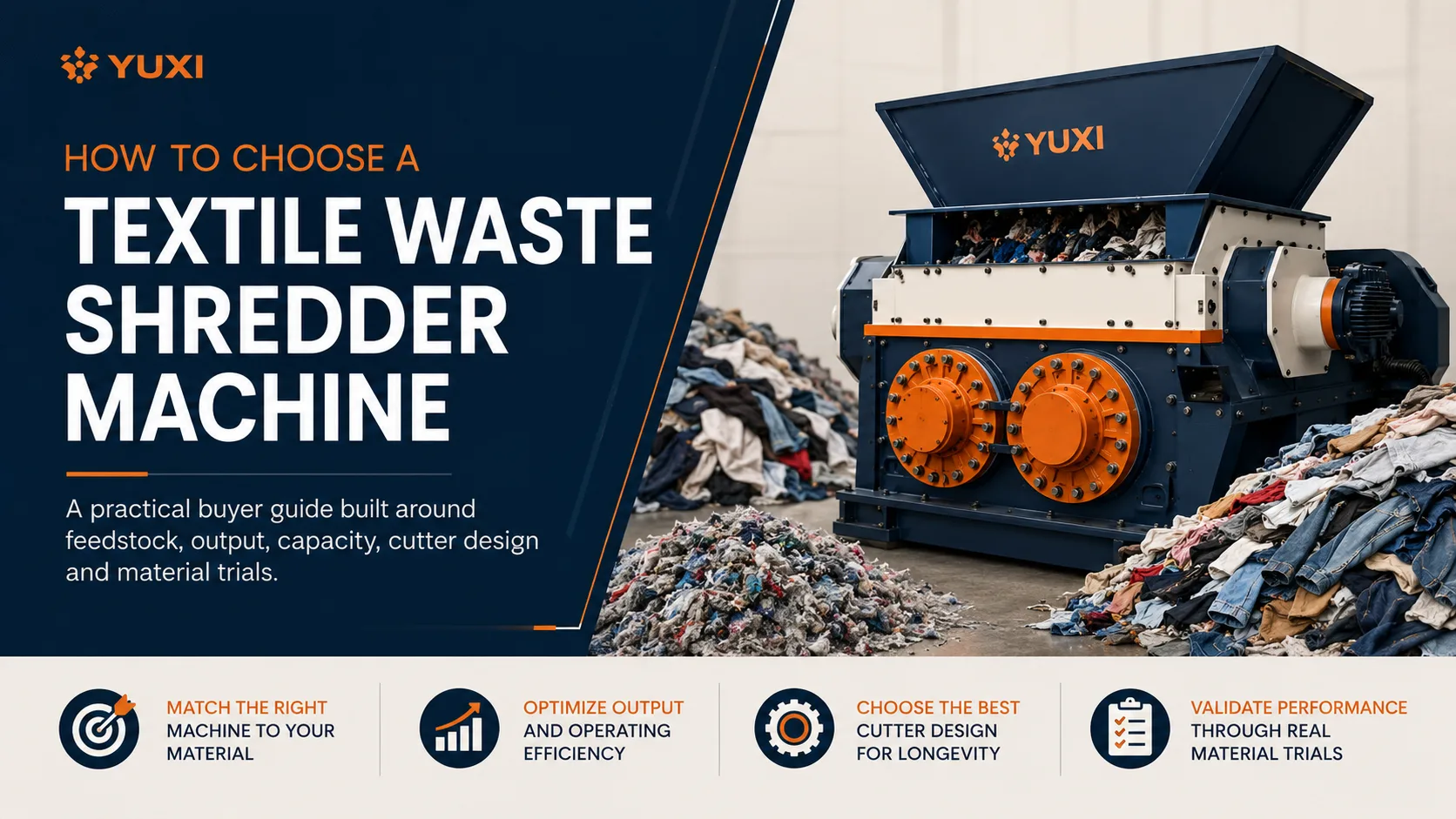
Quick Answer
Do not begin with motor power. First show the supplier what the material looks like when it reaches the machine, including the longest pieces and the normal level of zippers, buttons or other hard parts. A loose bag of cutting-room offcuts, a tightly compressed clothing bale and a continuous nonwoven roll may need completely different feeding arrangements even when the requested tonnage is the same.
Double-shaft shredders are often a good fit for coarse reduction of bulky, tangled textiles. They are not automatically the right answer when the next process needs a tightly controlled size or recoverable fiber. Final selection should follow a representative material trial.
A buyer once described his feed simply as “old clothes.” That phrase could mean sorted cotton shirts delivered loose, or mixed bales containing denim, elastic sportswear, buckles, wire and the occasional shoe. On a quotation sheet those projects can look identical. At the hopper, they are not.
This is why textile shredder selection is less about finding the largest model and more about defining the job. The machine has to accept the real feed without constant intervention, produce material the downstream equipment can use, and remain serviceable when fibers begin to collect where they should not.
Begin at the End of the Process
Before discussing shafts or kilowatts, decide what should happen after shredding. “Reduce the material to smaller pieces” is not a useful specification by itself.
Storage and transport
When the goal is volume reduction before baling, conveying or disposal, a coarse and somewhat irregular output may be acceptable. Paying for fine sizing would add wear and power without improving the result.
Secure destruction
Uniforms, branded garments and rejected stock must be damaged beyond reuse. The project needs a clear destruction standard. One coarse pass may not be enough.
Mechanical fiber recovery
Here the value is in the fiber, not the smallest particle. Aggressive cutting can shorten the usable fiber. Coarse shredding may only be the first step before controlled cutting, opening, cleaning and blending.
Chemical recycling or RDF
Chemical recycling usually places more emphasis on material purity and contaminant removal. RDF preparation follows another route, with attention to moisture, fuel specification and stable dosing.
A shredder therefore cannot be selected in isolation. Ask the downstream supplier for its maximum feed size, acceptable oversize, purity requirement and preferred feed form. Those limits are often more useful than a shredder brochure.
Describe the Feed as It Really Arrives
A garment factory cutting clean selvage waste and a recycler opening mixed clothing bales should not be offered the same machine simply because both materials are called textile waste.
| Feed | What usually matters | Questions to settle before selection |
|---|
| Garment offcuts | Light bulk density, irregular strips, generally low contamination | Longest strip, fabric construction, daily volume and feeding method |
| Yarn or spinning waste | Long fibers can wrap around cutters, spacers and shaft ends | Fiber length, elasticity, bundle size and cleaning access |
| Defective rolls and nonwoven web | Continuous material can be pulled in faster than expected | Roll width, core removal, unwinding control and need for pre-cutting |
| Post-consumer clothing | Mixed fibers, seams, zippers, buttons, rivets and unknown hard objects | Sorting level, metal content, bale opening and downstream separation |
| Carpet or coated fabric | Backing, adhesive, grit and layered construction increase wear | Backing type, contamination, required output and acceptable cutter wear |
| Quilts and bedding | Very low density, large volume, multiple layers and filling | How the material will be compressed, metered or pre-cut |
Fiber name alone does not tell the whole story. A thin polyester offcut may feed more easily than a heavy cotton garment with elastic seams and metal attachments. What the cutters feel is tensile strength, stretch, thickness, friction, layering and shape.
Moisture deserves a line in the specification as well. Damp fabric is heavier, can adhere inside the chamber and may carry dirt that accelerates wear. A dry sample taken from the top of a pile is not representative when the production feed is stored outdoors.
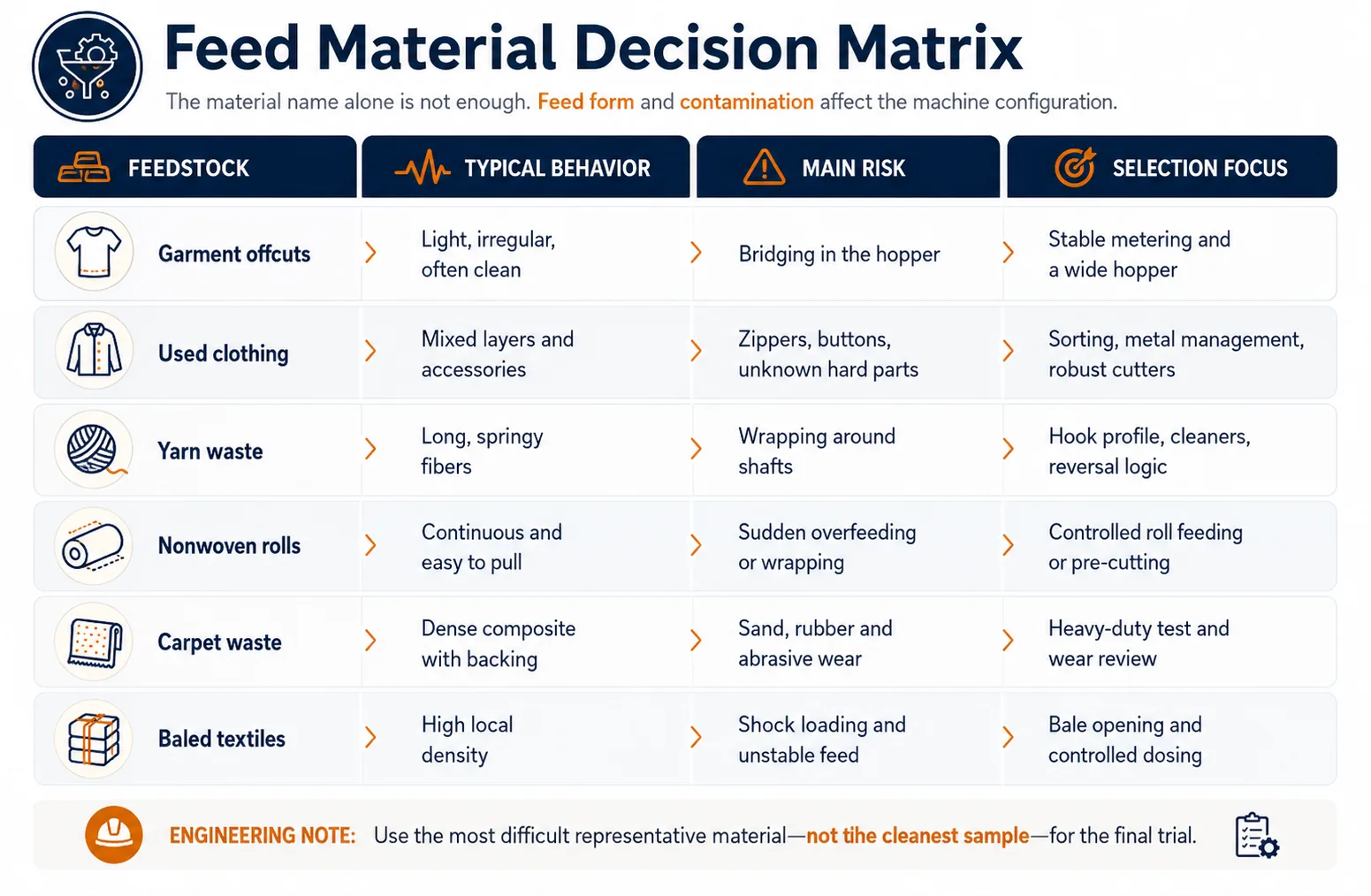
Comparison of textile waste feed forms and selection issues: The same nominal tonnage can behave very differently when feed form and contamination change.
Loose, Rolled and Baled Material Create Different Loads
Feed form changes the machine load before composition does.
Loose scraps can float above the cutters or bridge across the hopper. A roll can unwind and be pulled in as one continuous length. A dense bundle produces a sharp load that loose fabric never creates. Compressed clothing bales generally need to be opened and dosed; placing a full bale directly over the chamber is not a substitute for a feeding design.
Field observation: In many textile projects the chamber looks full while the actual mass flow remains low. The operator sees plenty of material, but the belt is carrying very few kilograms per meter. Increasing motor size does not correct that problem. Controlled metering usually does.
Moderate pre-compaction can help some low-density feeds, but it needs testing. Pack the material too tightly and the machine receives a dense plug instead of an even bed. That produces a much sharper torque peak.
Metal Accessories and Other Contaminants
Used clothing rarely arrives as pure fiber. Zippers, buttons, rivets, buckles, labels, plastic trim and bale wire are common. Carpet adds grit, backing and adhesive. Industrial fabric may contain coatings or reinforcing elements.
An industrial shredder may tolerate occasional accessories. That does not mean the line should accept unlimited metal without a penalty. Frequent hard impacts affect cutters, spacers and bearings, and the remaining metal can make the next recycling step unusable.
Be specific when discussing separation. A metal detector can identify many hard objects before they enter the chamber. A magnet removes ferrous pieces after shredding. Aluminum zipper parts and other non-ferrous metals need a different separation method, and very small accessories may remain trapped in the textile fraction.
Established textile conditioning lines often combine shredding with feeding and separation rather than treating the shredder as a stand-alone answer. The ANDRITZ textile conditioning overview, for example, lists feed origin, feeding method, particle size, cleanliness, accessories and downstream requirements as selection factors.
Which Machine Arrangement Fits the Job?
There is no useful answer to “Which textile shredder is best?” until the feed and the next process have been defined. The more practical question is what each arrangement does well—and what it asks the operator to live with.
Double-shaft shredders
Opposing cutter stacks hook, pull and shear the material at low speed. This arrangement is usually comfortable with bulky clothing, tangled scraps and mixed soft waste. It is particularly useful for front-end reduction where grabbing and volume reduction matter more than a precise final dimension.
The limitation is sizing. Without a screen, flexible pieces can fold or stretch and leave as longer strips. A downstream machine with a strict feed limit may require a return loop or a second cutting stage.
Single-shaft shredders
A hydraulic pusher feeds material toward one rotor, and a screen normally controls the maximum opening through which the material can leave. This can work well for consistent factory scrap when a more controlled size is needed.
Light, springy textiles can be awkward. They may bridge above the pusher, wrap around the rotor or collect near shaft ends. Review the hopper, pusher stroke, screen area and cleaning access with the actual feed—not with rigid plastic test pieces.
Four-shaft and secondary sizing arrangements
Many four-shaft designs use upper and lower cutter pairs, sometimes with a screen or internal return path, to improve repeated cutting. They can be useful where a single coarse pass leaves too much oversize. More shafts also mean more cutters, drive components and maintenance points, so the additional complexity should solve a demonstrated problem.
Cutters and fiber openers are different machines
A shredder reduces size. A rotary cutter produces more defined lengths. A textile opener tears fabric structure apart to recover fiber. A plant may need all three functions, but one heavy shredder cannot be expected to replace the others.
The distinction matters most in fiber-to-fiber projects. Specialist suppliers separate picking, cutting, tearing, metal detection and baling into different process stages. The textile recycling equipment overview shows how these functions are arranged around the required fiber quality.
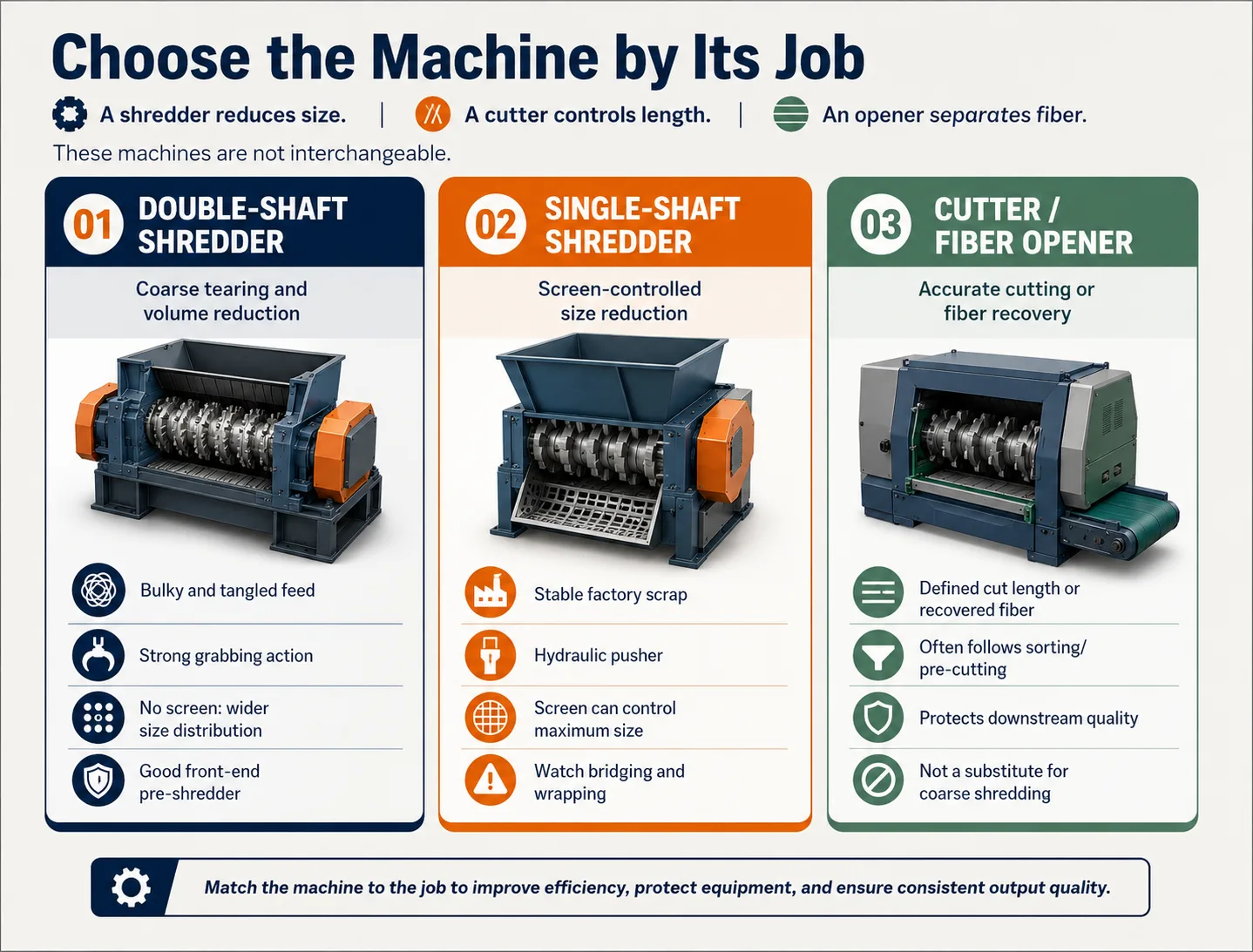
Comparison of double-shaft, single-shaft and textile opening equipment: Machine type should follow the feed behavior and the job assigned to that stage of the line.
Output Size Is a Distribution, Not a Promise
Buyers often read a nominal value such as 3–10 cm and assume every piece will fall within that window. That is rarely how an unscreened double-shaft machine behaves.
Cutter thickness influences the cut, but it is only one factor. Hook profile, cutter overlap, fabric elasticity, orientation and the number of times the material crosses the cutting zone all affect the result. A long strip can fold between the cutters and leave much longer than the nominal cutter width.
Ask for an output sample from your own material. Better still, weigh the oversize fraction against a simple limit agreed with the downstream supplier. “Looks small enough” is difficult to use during commissioning.
Reading the YXS reference table: The published range is useful for identifying general chamber and drive scale. It should not be treated as a textile throughput or output guarantee because feed density, feeding method and size distribution are not defined in the table.
Capacity: Measure Mass Flow, Not Hopper Volume
A shredder can appear busy all day and still miss the required tonnage. Textile waste is often limited by low bulk density and irregular feeding before it is limited by installed power.
Calculate the required sustained rate from annual or daily volume and the real operating window. Allow for breaks, cleaning, planned knife checks and downstream stops. Then test the proposed machine under the same feed form. A brochure maximum obtained from dense, easy material is not a safe basis for loose clothing or long yarn waste.
During a capacity discussion, provide:
Weight processed per day or shift
Actual running hours
Loose bulk density
Maximum piece, roll or opened-bale size
Normal contamination level
Required output and acceptable oversize
Whether material will be returned for another pass
Capacity limit of the downstream machine
There is no universal percentage for spare capacity. A clean factory line with stable offcuts may need less margin than a plant receiving seasonal mixed bales. The right allowance comes from feed variability and the operating plan.
Cutter Design, Wrapping and Cleaning Access
Textile buyers often ask for “anti-wrapping blades.” No cutter can make long, elastic fibers disappear as a maintenance issue. Good design reduces the frequency and makes the remaining cleanup manageable.
Review cutter thickness, hook count, hook profile, overlap, spacer and cleaning geometry, shaft-end protection and reversal logic. Then ask a less glamorous question: when material does wrap, how is it removed?
If routine cleaning requires pulling a complete shaft, the maintenance burden may be much higher than the quotation suggests. Access doors, safe lockout points and room for tools matter. So does the distance between the cutter stack and bearing seals, where fine lint tends to migrate.
Knife life should not be promised as a fixed number of months. Carpet grit, hidden wire and coated technical fabrics create a different wear pattern from clean cotton offcuts. A short trial can reveal chipping, impact damage or abnormal rubbing, but it cannot prove long-term service life.
Feeding, Controls and the Rest of the Line
The shredder is only one part of the handling problem. Manual loading may be acceptable for a small operation, but it produces variable feed and brings workers close to moving material. Belt conveyors improve consistency when bed depth and speed are controlled. Grab feeding handles bulky waste, though each grab can create a large load swing.
Roll stock may need an unwinding brake, roller feed or pre-cutting. Baled clothing often needs a bale opener and inspection point before metering. The hopper opening should match the feeding method, not merely the largest piece on a drawing.
Control logic is worth reviewing in plain language. When current rises, does the infeed slow before reversal? How many reversal attempts occur before the machine stops? Are the conveyors interlocked? Can the operator see the cause of repeated overload?
“PLC controlled” tells the buyer very little. The sequence does.
Confirm voltage, frequency, guarding, emergency stops, lockout points, cabinet protection and any dust or fire controls required by the site. Lint tends to collect in ledges, cable trays and bearing areas that look harmless during a clean factory demonstration.
Maintenance Cost Is Usually Hidden in the Quotation
Purchase price is easy to compare. The time needed to clear a wrapped shaft at the end of a shift is not.
| Service item | What to ask the supplier |
|---|
| Cutter access | Can wrapped textile be cleared through an access opening, and where are the lockout points? |
| Blade replacement | Must the full shaft be removed? What lifting equipment and labor are required? |
| Bearing protection | How are lint, dust and moisture kept away from seals and bearing housings? |
| Lubrication | Which points are manual, and which can be centralized or automatic? |
| Spare parts | Which cutters, spacers, seals and sensors should be held locally? |
| Documentation | Are maintenance procedures, electrical drawings and parts lists supplied in English? |
A heavier frame may improve rigidity, but weight alone is not proof of a better machine. Look at shaft support, bearing layout, gearbox mounting and the room available for service. Extra steel is useful when it supports the load path. It is less useful when it blocks access to the components that need attention.
A Material Trial Should Try to Find the Weak Point
A supplier can make almost any shredder look convincing for thirty seconds by feeding one prepared piece at a time. The useful part of the test begins when material is fed continuously, the longest pieces are included and somebody records how often the machine reverses or needs cleaning.
Send the difficult normal feed, not just the cleanest sample. For post-consumer clothing, include the accessories that will actually arrive. For factory scrap, include the longest strips or rolls. When production feed comes from opened bales, test that form and the proposed metering method.
Record more than the video
Actual feed weight
Stable running time
Net throughput
Motor current or load
Number of reversals
Locations where fiber collects
Unshredded or oversize fraction
Output size distribution
Cleaning time after the run
Any cutter chipping or impact marks
The goal is not a perfect demonstration. It is to discover what will interrupt production before the equipment is shipped.

Textile shredder selection workflow from downstream use to material testing: Model selection comes after the process, material, output and capacity have been defined.
Compare Quotations Without Comparing Different Machines
One supplier may include conveyors, a platform, control integration and spare cutters. Another may quote only the shredder. The lower number is not necessarily the lower project cost.
Put quotations on the same basis:
The same material and contamination assumption
The same sustained capacity and operating schedule
The same output limit and permitted oversize
The same feeding, discharge and return scope
The same electrical and guarding standard
The same metal detection, separation and dust-control boundary
The same spare parts, special tools and documentation
The same installation, commissioning, training and Incoterm
Ask each supplier to state exclusions. Rebuilding a hopper or adding a second sizing machine after installation is usually more expensive than defining the requirement at the start.
Where a YUXI Double-Shaft Textile Shredder Fits
A YUXI textile waste shredder machine is most relevant when a project needs front-end coarse reduction of bulky, tangled or irregular material such as garment offcuts, used clothing, cotton yarn waste and nonwoven scrap. The double-shaft arrangement is a sensible starting point when grabbing and volume reduction matter more than a tightly screened final size.
It should not be sold as a complete fiber-recovery line. Projects requiring reusable fiber, a narrow size distribution, high-purity chemical recycling feed or extensive accessory removal normally need additional sorting, cutting, opening, separation or secondary reduction.
Information needed before model selection: material composition, photos and video, feed form, loose bulk density, maximum dimensions, moisture condition, hard contaminants, sustained hourly requirement, operating schedule, required output, downstream process and site electrical standard.
Frequently Asked Questions
The answer depends on the feed and the next process. Double-shaft machines are commonly used for coarse reduction of bulky or tangled textiles. A screen-equipped single-shaft machine can be useful when maximum output size needs tighter control. Fiber recovery may also require cutting, opening and cleaning equipment after shredding.
Occasional accessories may be acceptable in a suitably configured industrial shredder, but their type and quantity must be defined. Ferrous metal can be detected or removed magnetically, while aluminum and other non-ferrous attachments need different separation. Heavy contamination should be removed before shredding whenever practical.
Use a timed trial with representative material in its normal feed form. Record feed weight, stable running time, motor load, reversals, wrapping, oversize material and cleaning time. A short demonstration with prepared pieces is not a reliable capacity test.
Usually not in one pass when no sizing screen is fitted. The machine produces a distribution influenced by cutter thickness, hook geometry, overlap, fabric elasticity and feed orientation. Strict downstream limits may require recirculation or a secondary sizing stage.
Send material in the form expected at the plant. Loose offcuts are suitable when production feed is loose. A project receiving compressed bales should also test opened bale material and the proposed metering method. Do not prepare every sample into small, easy pieces.
The quotation should define the feed assumption, sustained capacity basis, cutter configuration, feeding and discharge scope, controls, guarding, electrical standard, spare parts, installation support, exclusions and commercial terms. Compare suppliers only after these boundaries are aligned.
Before the Model Is Finalized
For loose factory offcuts, clear photos, dimensions and a bulk-density measurement may be enough to narrow the model range. Long rolls, baled post-consumer clothing and material containing metal accessories need a more cautious approach.
In those cases, do not finalize the cutter or feeding arrangement until the difficult feed has been run through the proposed machine. The test result is more valuable than another line in the catalog.

 Shredding Machine
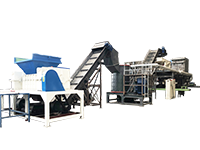 Waste Recycling Line
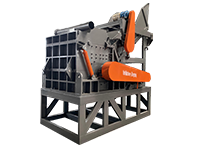 Optional Equipment