Selecting a tire crumb rubber recycling system is a complex engineering task that requires balancing throughput, output quality, and operating costs. In many commercial recycling projects, as an engineer, your goal is to design or select a production line that maximizes the recovery of high-value rubber while minimizing energy consumption and maintenance downtime. This guide outlines the key technical factors that need to be evaluated when selecting a system.
For any business model, financial planning is crucial. After confirming necessary conditions such as location, licenses, personnel, and market, the next important step is choosing the right machinery and production line.
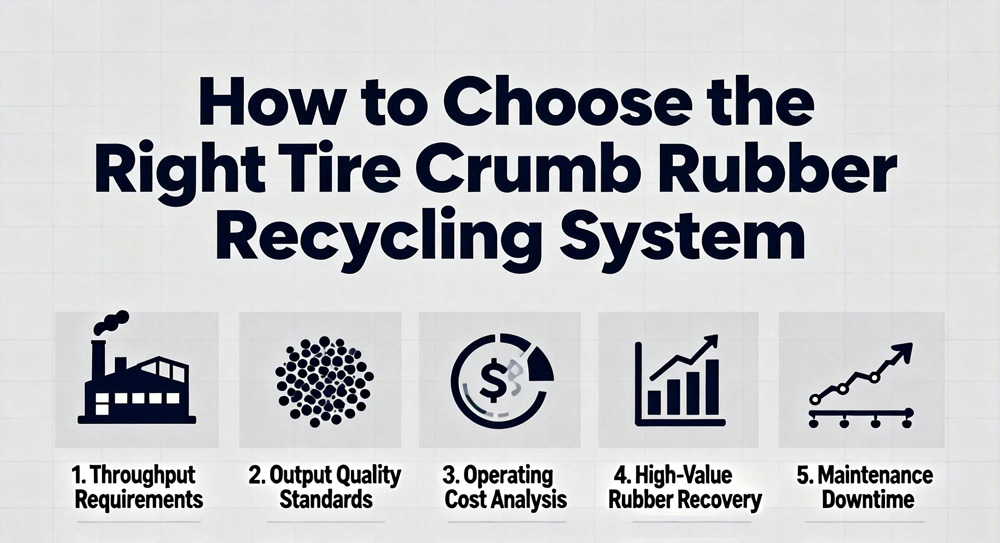
Financial planning is crucial for any business model. After confirming the necessary conditions such as location, licenses, personnel and market, the next important step is to select the right machinery and production line.
1. Determine your production requirements (“mesh” factor)
The most important technical specification is the required fineness of the final product. Different applications require different particle sizes (mesh counts). Your system must be configured to meet these requirements:
Rubber mulch (10-20 mm): for landscaping and playgrounds. A tire shredder machine is required to process 50 mm rubber blocks into clean crumbs.
Rubber granules (1-6 mm): for sports tracks and safety mats. Requires a rubber granulator for fine grinding.
Rubber powder (30-120 mesh): used for modified bitumen and waterproofing membranes. Requires a dedicated rubber grinder or crusher.
RequirementEngineering Tip: Ensure that the system includes a vibratory sifter to re-route oversize material back to the grinding circuit, thus ensuring consistent output size.
2. Evaluate the efficiency of multi-stage processing
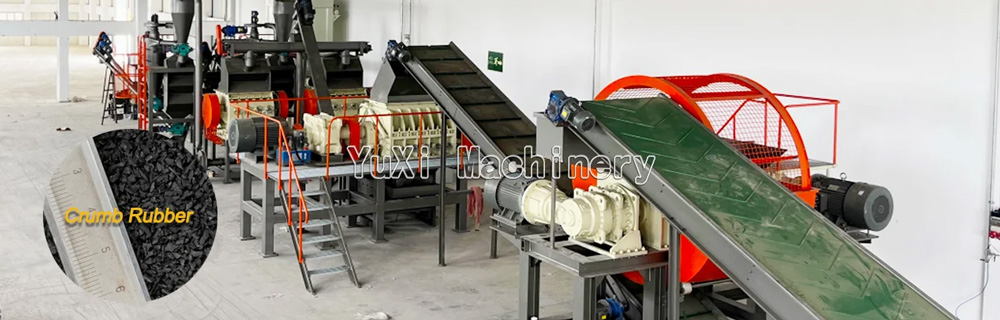
A professional recycling system is not a single machine, but a multi-stage process. Evaluate the efficiency of each stage:
Stage 1: Pre-treatment and coarse crushing
The system must be able to process all types of tires (construction tires, truck tires, car tires). A tire de-wireer is first needed to remove steel wires from the bead, followed by a tire shredder, which should have a high torque and low energy consumption and be able to shred the entire tire into 50 mm pieces of rubber.
Stage 2: Separation technology
The value of rubber granules depends on their purity. Your system must excel in the following areas:
Wire separation: High-intensity magnetic separators should achieve a separation rate of at least 97%.
Fiber separation: choose equipment with integrated air separation and screening technology to remove textile fibers, which are common contaminants in car tires.
3. Component durability and maintenance
From an operational point of view, the “cost per ton” depends mainly on wear parts. In a tire recycling line, blades and screens are under constant stress.
Blade Material: Insist on high alloy, wear-resistant steel for the blades of shredders and granulators.
Modular design: Minimize downtime by choosing equipment that allows for quick blade adjustments and changes.
Bearing Protection: Ensure that all rotating shafts are equipped with sealed bearings to prevent rubber dust and fine steel wires from causing premature mechanical failure.
4. System integration and automation
A well-designed system should be a well-coordinated and integrated whole. Please note the following points:
Conveyor Belt Synchronization: The automatic feeding system adjusts to the load of the main crusher to prevent clogging.
Dust Removal: The integrated pulse dust removal system maintains a clean working environment and complies with environmental standards.
Scalability: Can the system be upgraded, for example by adding additional granulators or mills, if your production needs increase?
Technology Selection Summary
| Feature | Requirement | Engineering Benefit |
| Primary Shredder | High-Torque, Low-Speed | Efficiently breaks down whole tires with minimal heat buildup. |
| Magnetic Separator | >97% Sorting Rate | Produces high-purity rubber and protects downstream blades. |
| Fiber Separator | Air Suction + Sieving | Removes textile contaminants for high-grade crumb rubber. |
| Granulator | Adjustable Screen Sizes | Allows for flexible production of various mesh sizes (1-6mm). |
| Control System | PLC Integrated | Ensures synchronized operation and prevents equipment overload. |
Conclusion
Choosing the right tire crumb rubber recycling system requires a deep dive into the technical specs. Don't just look at the price tag; look at the sorting rate, the blade alloy, and the system's ability to handle fibers. Yuxi provides comprehensive technical support to assist you in setting up your production line. A well-engineered line will pay for itself through lower maintenance costs and a higher-quality end product that commands a premium price in the market. Focus on the engineering fundamentals, and you'll secure a reliable, long-term recycling solution.

 Shredding Machine
 Waste Recycling Line
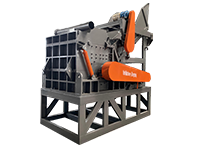 Optional Equipment