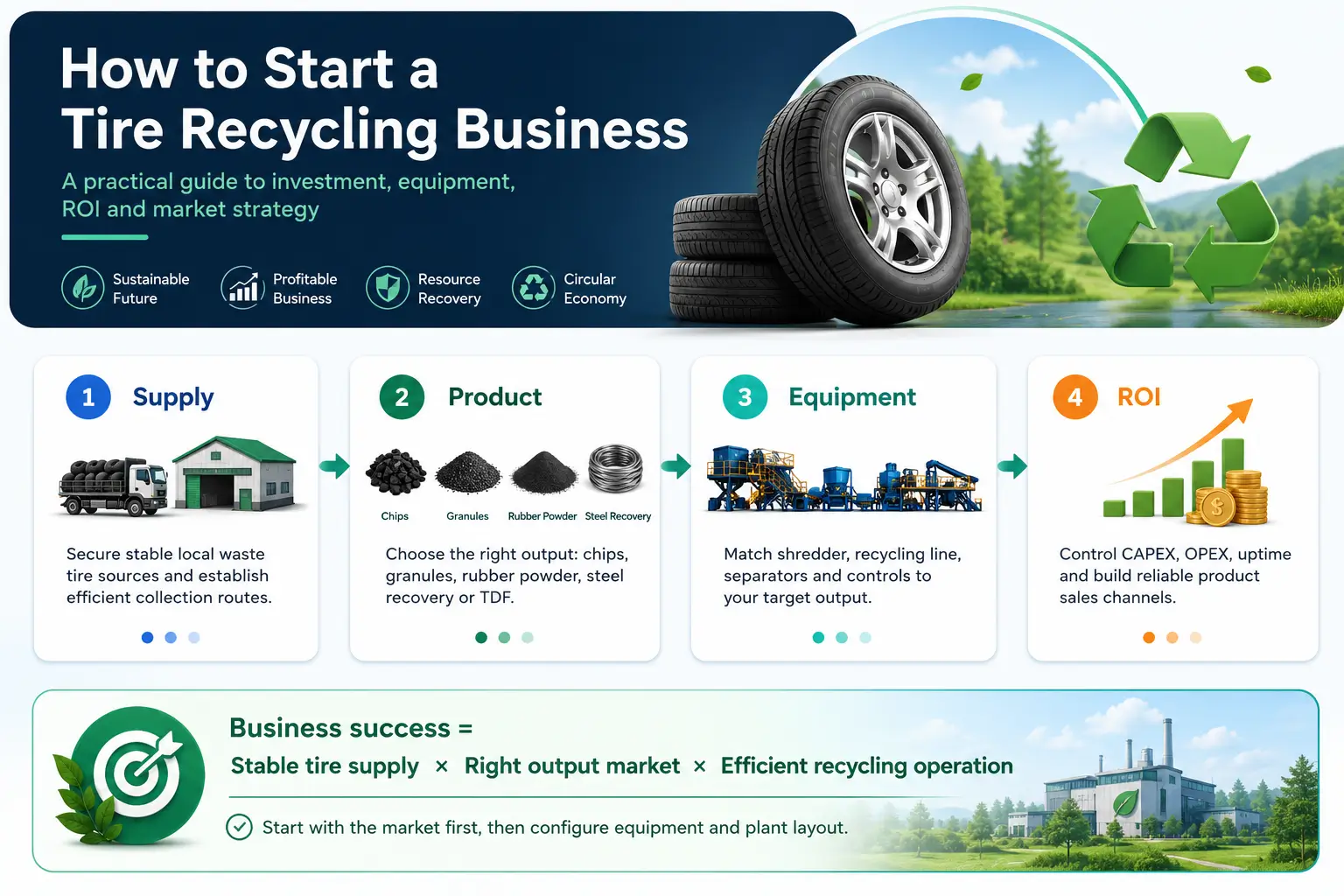
Starting a tire recycling business is not simply buying a tire shredder and waiting for profit. A successful project needs stable tire supply, a clear product market, the right recycling equipment, cost control, plant layout, and a realistic ROI model. If any one of these parts is weak, the business may struggle even if the machine itself works.
This guide is written as a practical business blueprint for investors, waste management companies, recycling operators and industrial buyers who are evaluating a waste tire recycling project. It belongs to the Waste Tire Recycling Line Plant topic cluster, because the main search intent is not only equipment selection. The user wants to understand how to build a complete tire recycling business.
The core idea is simple: tire recycling is no longer only a waste disposal activity. It is a material recovery and manufacturing business. Scrap tires can be processed into rubber chips, rubber granules, rubber powder, recovered steel wire, fiber, tire-derived fuel, and other marketable materials. The right business model depends on local tire supply, buyer demand, energy cost, labor cost and output quality.
1. Why tire recycling is becoming a global opportunity
Every country faces the same long-term problem: tires wear out, but they do not disappear. End-of-life tires take space, create fire risk, and waste valuable rubber and steel resources if they are not processed properly. At the same time, many industries need recycled rubber, fuel alternatives, civil engineering materials and steel recovery. This combination creates a strong business opportunity for tire recycling operators.
The U.S. EPA identifies three large scrap tire markets: tire-derived fuel, civil engineering applications, and ground rubber applications including rubberized asphalt. It also lists other uses such as whole or cut tire products, retreading and pyrolysis. Source: U.S. EPA Scrap Tire Markets
USTMA reported that in 2023, 79% of end-of-life tires in the United States were reclaimed or recycled, up from 71% in 2021. This shows that the market is active, but it also proves an important point: recycling capacity only becomes valuable when it connects to real end markets. Source: USTMA 2023 End-of-Life Tire Management Report
Grand View Research estimates the global tire recycling market at USD 6.87 billion in 2024 and projects it to reach USD 8.46 billion by 2030, with demand from construction, asphalt modification, automotive components and sports surfaces. Source: Grand View Research Tire Recycling Market Report
For a recycling investor, these references support a clear conclusion: tire recycling has long-term demand, but the winning projects are not the ones that simply process more tires. The winning projects produce the right output for the right market at the right cost.
2. Quick answer: is starting a tire recycling business profitable?
Yes, a tire recycling business can be profitable. But the profit is not automatic. It depends on the local business model. A plant with stable tire supply, low transport cost, reliable equipment and confirmed buyers for rubber and steel may generate healthy cash flow. A plant with high feedstock cost, weak buyers or frequent downtime may struggle.
| Plant type | Estimated investment | Business direction | Profit condition |
| Small tire recycling setup | US$50,000–US$120,000 | Local collection, chips, simple processing | Works best with low feedstock cost and simple end markets |
| Medium recycling line | US$120,000–US$300,000 | Rubber granules, steel recovery, commercial operation | Best balance for many private investors and recyclers |
| Large automated plant | US$300,000–US$800,000+ | High-volume recycling, multiple outputs, lower labor dependence | Requires stable tire supply and mature output markets |
Profit is usually driven by four variables: tire supply cost, output selling price, plant uptime and operating cost. If these variables are understood before buying equipment, the project has a much better chance of success.
3. Understand the tire recycling business model
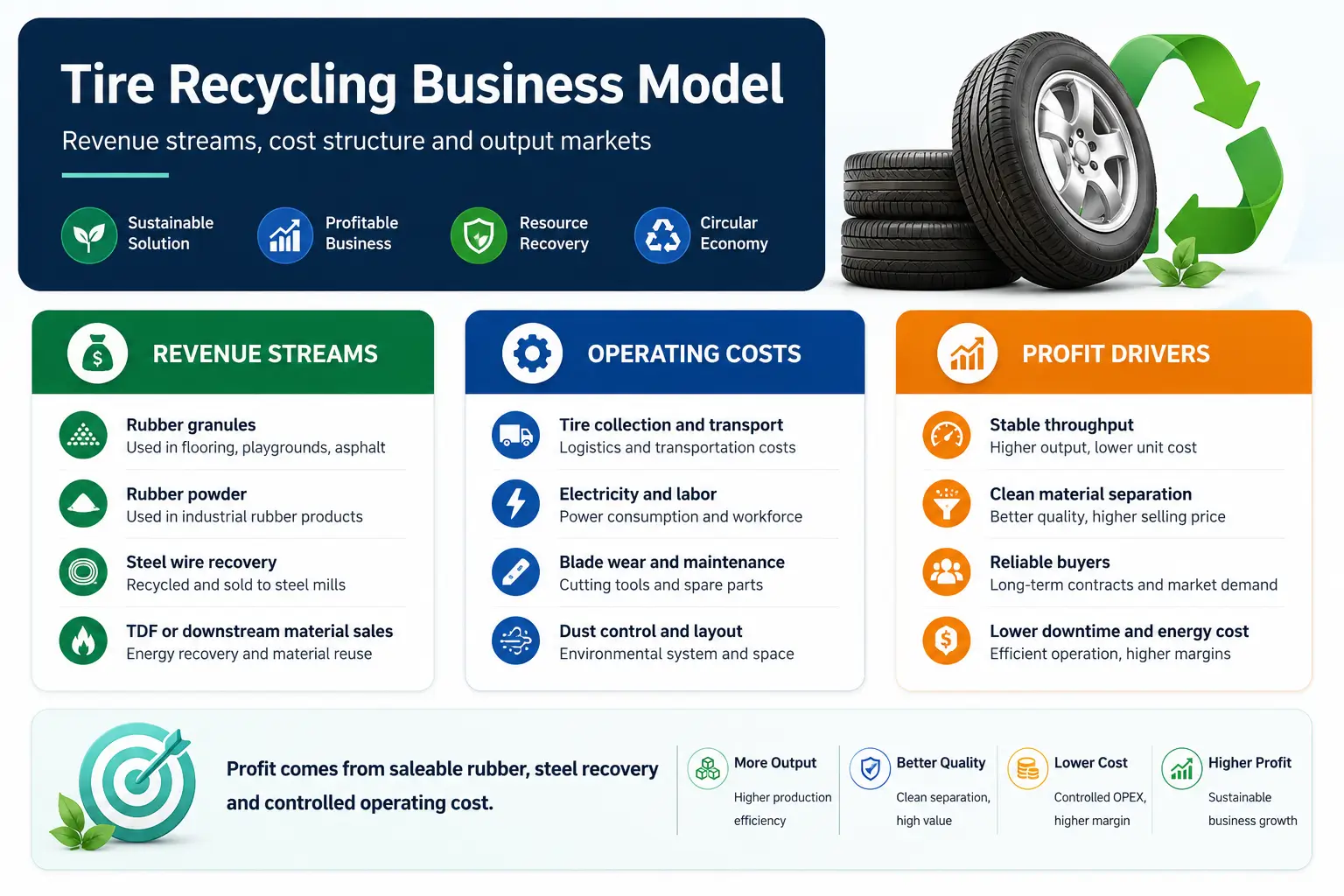
A tire recycling business makes money by converting end-of-life tires into products that another buyer can use. The revenue model may include rubber granules, rubber powder, steel wire recovery, tire-derived fuel, tire-derived aggregate, civil engineering material, or pre-processed feedstock for pyrolysis.
Rubber granules
Rubber granules are commonly used in playground surfacing, sports flooring, rubber mats, molded products and other rubber applications. This is one of the most important output markets for investors who want to build a value-added recycling business.
Rubber powder
Rubber powder may be used in modified asphalt, rubber products, coatings and other downstream applications, depending on mesh size and purity. Producing fine powder usually requires more equipment and energy, but it may also open higher-value markets.
Steel wire recovery
Many first-time investors underestimate steel recovery. Tires contain steel wire, and clean separation can create an additional revenue stream. Poor steel separation also lowers rubber quality, so the separation system affects both revenue and product acceptance.
Tire-derived fuel and civil engineering material
Some markets use tire-derived fuel in industrial applications. EPA also describes civil engineering uses where scrap tire shreds can replace certain construction materials such as lightweight fill, drainage aggregate and other fill materials. Source: U.S. EPA Civil Engineering Applications
The key business lesson is this: do not start with equipment first. Start with the output market. Once you know what you can sell, you can choose the right recycling process.
4. Step-by-step guide to starting a tire recycling business
Step 1: Study your local tire supply
Stable tire supply is the foundation of the business. Before buying equipment, calculate how many waste tires are available every month, where they come from, what types of tires they are, and how much it costs to collect or purchase them. Whole tires are bulky, so transport distance matters. A plant can look profitable on paper but lose margin if tires must be collected from too far away.
Step 2: Define your final product
The final product determines the equipment. If you only want tire chips, a shredder may be enough. If you want rubber granules, you need a recycling line with granulation, magnetic separation and fiber separation. If you want fine rubber powder, you need further grinding, screening and dust control.
| Target product | Typical equipment direction | Business note |
| Tire chips | Tire shredder | Lower equipment complexity, lower product value |
| Rubber granules | Shredder + granulator + separation system | Balanced model for many commercial recyclers |
| Rubber powder | Full recycling line + fine grinding system | Higher value potential, higher power and quality requirements |
| Steel recovery | Magnetic separation and steel handling | Adds revenue and improves rubber purity |
Step 3: Choose the right tire recycling equipment
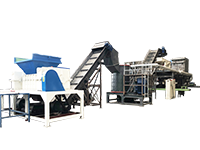
The equipment should match your business model. ShreddingTech’s Full-automatic Waste Tire Recycling Line is listed with production capacity of 200–10,000 kg/h, suitable tire diameter of 400–4,000 mm, output size from 140 mesh to 100 mm with customization available, automatic separation of rubber, wire and nylon fiber, and PLC control. This makes it suitable for buyers who want a complete recycling line rather than only size reduction.
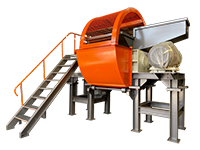
For front-end size reduction, ShreddingTech’s Waste Tire Shredder Machine lists feeding size of 100–2,600 mm or customized, discharging size of 50–100 mm, and production capacity of 0.4–60 t/h. The site also notes that the machine can handle steel wire tires below 4,000 mm diameter and that site design can be provided according to factory size.
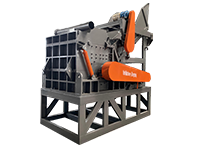
Related equipment such as the Waste Tire Granulator and Tire Steel Wire Drawing Machine can support a more complete tire recycling process.
Step 4: Calculate investment and operating cost
Investment cost includes equipment, installation, factory preparation, electrical systems, conveyors, dust collection, spare parts and layout work. Operating cost includes electricity, labor, tire collection, blade wear, maintenance, downtime, packaging, storage and sales logistics. The plant should be evaluated by total cost of ownership, not only machine price.
Step 5: Build buyer channels before production
Do not wait until rubber output is produced to find buyers. Speak with rubber product manufacturers, sports surface companies, asphalt contractors, scrap steel buyers, civil engineering contractors and other potential customers before choosing final output size. Buyer specifications should guide equipment configuration.
5. How much does it cost to start a tire recycling business?
The total cost depends on plant size, output target and automation. The following table gives practical planning ranges.
| Cost level | Estimated range | What it may include |
| Small line | US$50,000–US$120,000 | Primary shredding, simple material handling, lower automation |
| Medium line | US$120,000–US$300,000 | Shredding, granulation, steel separation, screening and basic controls |
| Large automated plant | US$300,000–US$800,000+ | Full line, PLC control, multiple separation stages, dust control and custom layout |
These ranges are not final quotations. A complete project should be calculated according to tire type, capacity, output size, local electricity cost, labor cost and factory layout.
6. What equipment is needed in a tire recycling plant?
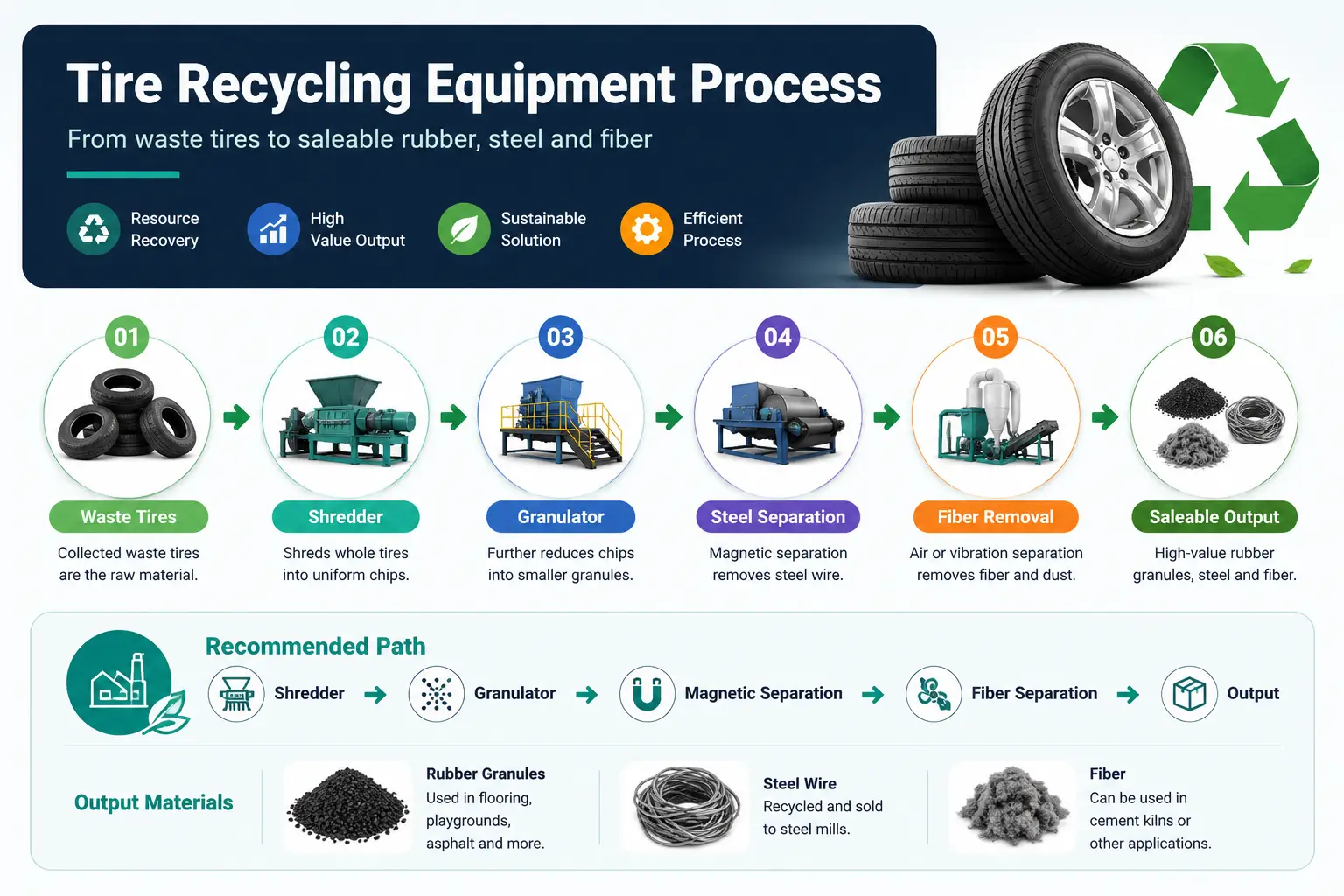
A tire recycling plant normally includes several machines working together. The equipment path depends on whether you want chips, granules or powder, but a complete commercial line often follows this logic:
Tire collection and sorting: separate passenger tires, truck tires and oversized tires.
Steel wire drawing or debeading: removes bead wire for easier processing when required.
Primary shredding: reduces whole tires into smaller rubber pieces.
Granulation: reduces rubber pieces into smaller particles.
Magnetic separation: removes steel wire from rubber output.
Fiber separation: removes textile fiber and light impurities.
Screening: controls particle size and returns oversized material.
Dust collection: improves workshop environment and safety.
PLC control and conveyors: stabilize line operation and reduce manual handling.
This is why the plant should be designed as a system. A good shredder helps the granulator. Good separation improves rubber value. Good layout reduces labor and downtime.
7. How to choose the right tire recycling line
The right line is not always the biggest or most expensive one. It is the line that matches your raw material, output market and operating conditions.
| Decision factor | Why it matters |
| Capacity | Should match real tire supply, not only future ambition |
| Output size | Determines whether you need shredding, granulation or fine grinding |
| Automation level | Affects labor cost, safety and output stability |
| Separation quality | Clean rubber and steel recovery improve revenue potential |
| Power consumption | Electricity can significantly affect profit in some countries |
| Maintenance access | Downtime directly reduces monthly output |
| Factory layout | Good material flow reduces handling cost and safety risk |
8. Why full-automatic tire recycling lines matter
Full-automatic lines usually require higher initial investment, but they can create stronger long-term economics. Automation can reduce labor dependence, improve output consistency, coordinate each machine, reduce manual feeding risk and make maintenance easier. For buyers planning a commercial recycling plant, automation is not simply a feature. It is part of the business model.
ShreddingTech’s full-automatic line uses PLC control and is designed for automatic separation of rubber, wire, nylon fiber and other materials. These points matter because the buyer’s profit depends on clean output, stable operation and lower downtime.
9. Real ROI example: 5 ton/hour tire recycling plant
ROI varies by region, but the logic is always similar. A 5 ton/hour plant running 8 hours per day and 22 days per month may process about 880 tons of material per month. Revenue may come from rubber granules, steel wire and other outputs. Costs may include tire purchase or collection, electricity, labor, wear parts, maintenance and logistics.
| Example item | Planning assumption |
| Capacity | 5 tons/hour |
| Working time | 8 hours/day, 22 days/month |
| Monthly input | About 880 tons |
| Revenue sources | Rubber granules, steel wire, possible fiber or downstream products |
| Main costs | Feedstock, electricity, labor, blade wear, maintenance and logistics |
| ROI range | Often discussed around 6–18 months, depending on local conditions |
The most important point is that ROI should be calculated from local data. If waste tires are cheap and buyers are strong, ROI can improve. If collection distance is long or electricity is expensive, ROI becomes weaker.
10. Common mistakes new investors make
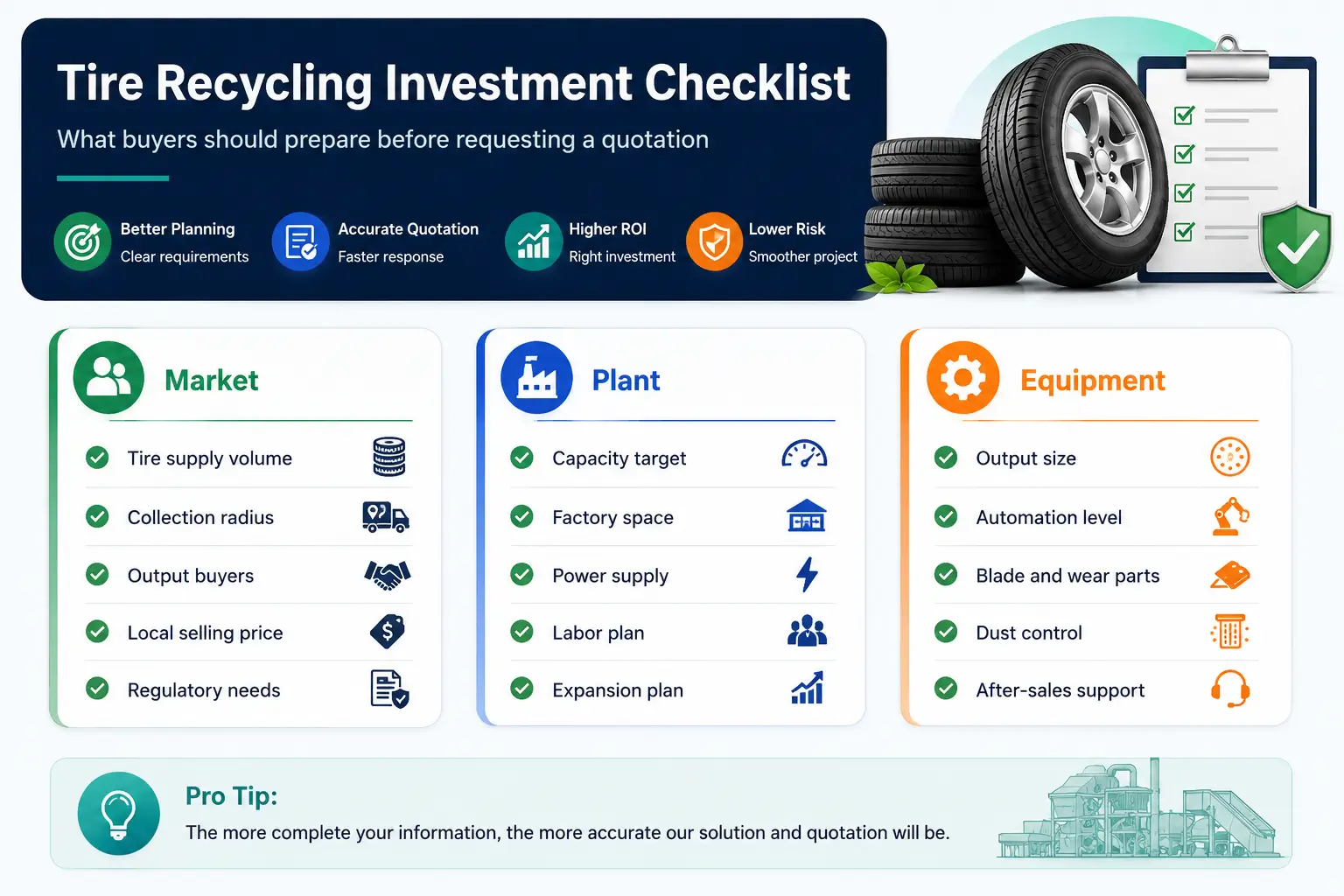
Buying equipment before confirming tire supply: no stable feedstock means no stable production.
Choosing output without confirmed buyers: rubber powder or granules only matter if buyers need them.
Only comparing machine price: cheap equipment may lead to higher downtime and maintenance.
Ignoring electricity cost: power consumption can affect profit significantly.
Underestimating blade wear and spare parts: wear parts are a real operating cost.
Poor factory layout: bad material flow increases labor and safety risks.
Using a shredder as a full recycling line: shredding is only one stage of material recovery.
No sales plan: a plant should be designed around buyers, not only around machinery.
11. FAQ
Is tire recycling profitable?
Yes, it can be profitable when the business has stable tire supply, confirmed output buyers, controlled operating cost and reliable equipment. Profit is not guaranteed by equipment alone.
How much does it cost to start a tire recycling business?
A small setup may cost around US$50,000–US$120,000, a medium line may cost US$120,000–US$300,000, and a large automated plant may exceed US$300,000–US$800,000 depending on configuration.
What equipment is needed?
A typical line may include tire shredding, granulation, magnetic separation, fiber separation, screening, dust collection, conveyors and PLC control. Some projects also need steel wire drawing or debeading.
Is a tire shredder enough?
A tire shredder is enough for basic size reduction, but a recycling business usually needs downstream separation and granulation to produce higher-value saleable output.
What is the best tire recycling product?
The best product depends on local demand. Rubber granules, rubber powder, tire-derived aggregate, tire-derived fuel and recovered steel all have different markets and requirements.
How much space is required?
Space depends on capacity, tire storage, equipment layout, output storage, truck access and safety requirements. A complete commercial plant needs more space than a standalone shredder.
Can truck tires be recycled?
Yes. Truck tires can be recycled, but they require suitable equipment because they contain stronger structures and more steel than passenger tires.
Conclusion: build a business system, not just a machine line
Starting a tire recycling business requires more than equipment. The correct order is market research, tire supply planning, output strategy, cost calculation, equipment selection and plant layout. If you follow this order, the equipment quotation becomes much more meaningful.
For buyers who want a complete tire recycling plant, ShreddingTech / Yuxi can be positioned as a solution partner rather than only a machine supplier. The company offers tire shredders, full-automatic waste tire recycling lines and related equipment that can be configured around tire type, capacity, output size and factory layout.
Get a custom tire recycling business plan
Recommended CTA: Send your tire type, expected capacity, target output size, factory space and local buyer market to Yuxi / ShreddingTech engineers. The team can recommend a complete tire recycling line configuration, plant layout and ROI direction for your project.
Contact Yuxi ShreddingTech for a project discussion

 Shredding Machine
 Waste Recycling Line
 Optional Equipment