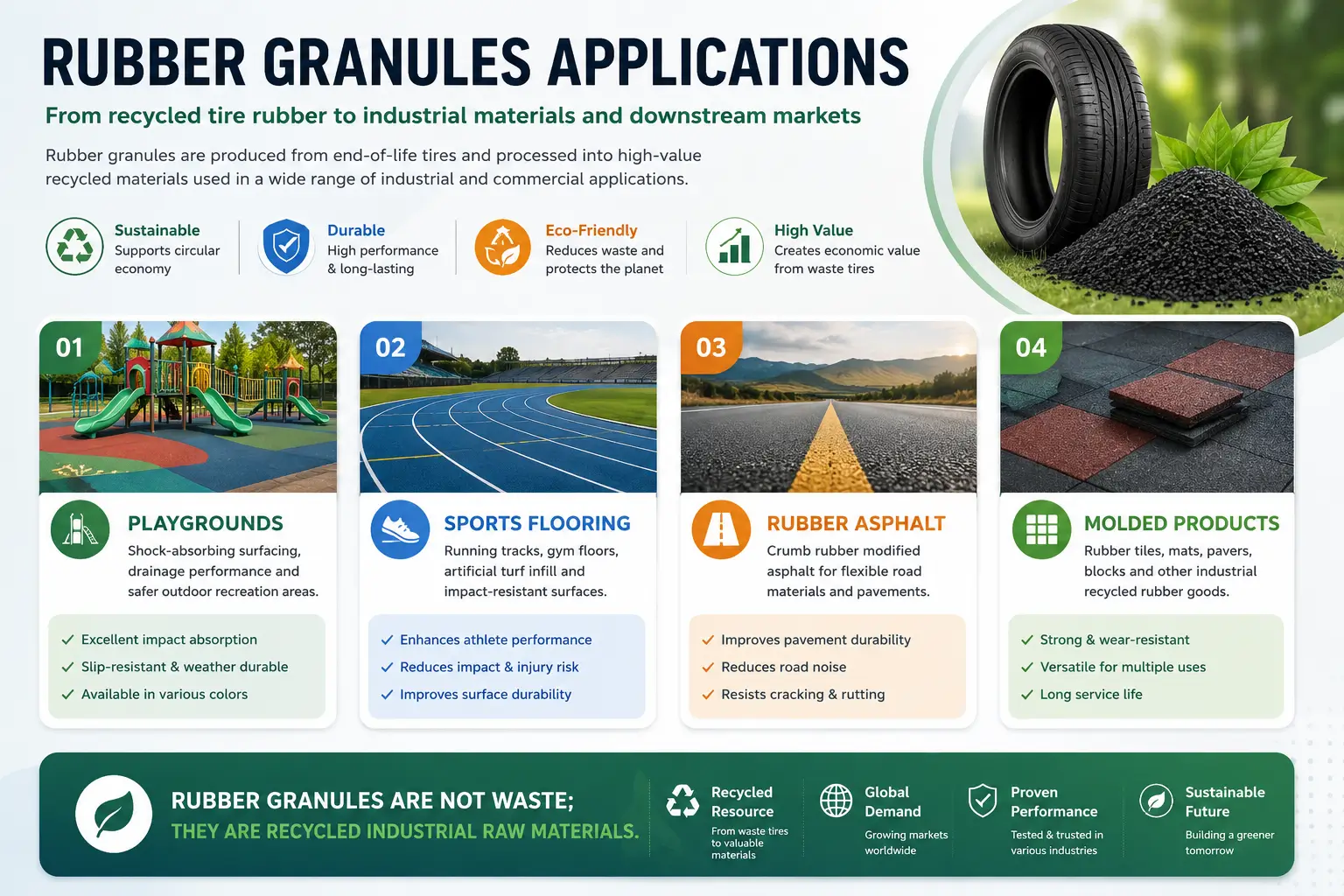
Rubber granules are not just a by-product of tire recycling. In many downstream markets, they are treated as recycled industrial raw materials. They can be used in playground surfacing, sports flooring, artificial turf infill, rubber asphalt, molded rubber products, drainage layers and other civil engineering applications.
For tire recycling companies, rubber granules are also important because they connect equipment investment with real market demand. A recycling line does not create value simply by shredding tires. It creates value when it produces clean, consistent and saleable rubber materials that downstream buyers can use.
This article is written as a cluster page for the ShreddingTech Waste Tire Recycling Line Plant. It explains not only where rubber granules are used, but also why particle size, steel removal, fiber separation and production process design matter for commercial tire recycling projects.
1. What are rubber granules?
Rubber granules are recycled rubber particles produced from waste tires through shredding, granulating, magnetic separation, fiber separation and screening. Depending on particle size and purity, they may be used as surface materials, infill materials, asphalt modifiers, molded product feedstock or civil engineering materials.
The U.S. EPA identifies major scrap tire markets including tire-derived fuel, civil engineering applications and ground rubber applications such as rubberized asphalt. This confirms that recycled tire rubber is not limited to one use; it serves several industrial markets. Source: U.S. EPA Scrap Tire Markets
In tire recycling, the main difference between low-value and higher-value rubber material is often quality. Cleaner granules with consistent size, lower steel content and lower fiber residue are usually easier to sell into demanding applications.
2. Rubber granule sizes and application matching
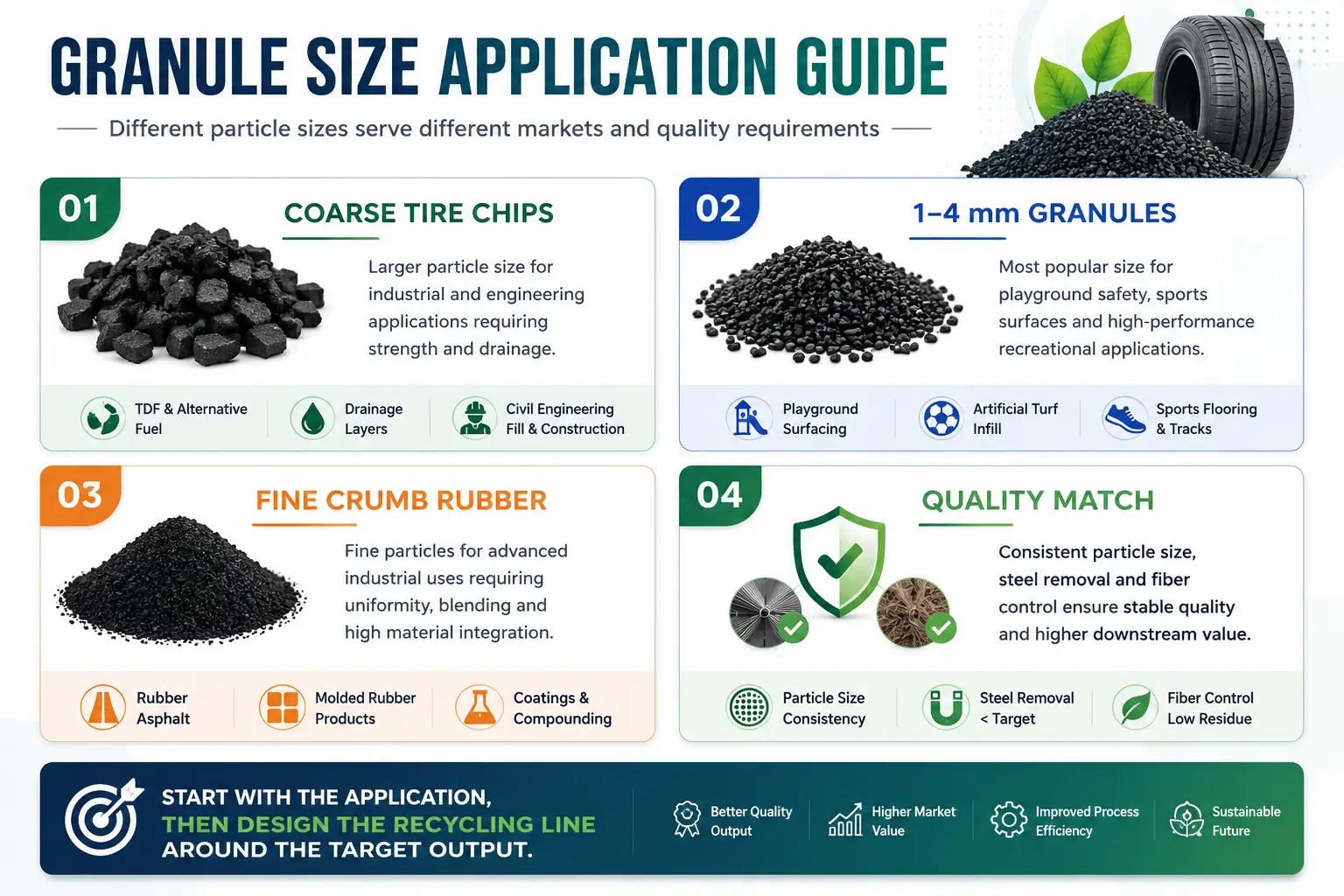
Different applications require different rubber particle sizes. This is one of the most important points many simple “rubber granules uses” pages ignore. A buyer for playground surfacing does not need the same material as a buyer for asphalt modification or drainage fill.
| Material form | Typical use | Key requirement |
| Coarse tire chips | TDF, drainage, civil engineering fill | Durable size reduction and stable supply |
| Medium rubber granules | Playgrounds, artificial turf, sports flooring | Impact performance, drainage, particle consistency |
| Fine crumb rubber / powder | Rubber asphalt, molded rubber products, compounds | Fine grading, lower contamination, better mixing behavior |
In practical production, this means the equipment configuration should be selected according to the target output. If the target is coarse chips, a simpler shredding system may be enough. If the target is sports flooring or molded products, the plant needs stronger granulating, steel separation, fiber separation and screening.
3. Main rubber granules applications
Playground surfacing
Playground surfacing is one of the most visible recycled rubber applications. Rubber granules are used to create impact-absorbing surfaces that can improve safety, drainage and slip resistance. For this application, particle consistency and cleanliness are important because the material is exposed to foot traffic and weather.
Sports flooring and running tracks
Sports flooring uses rubber granules for elasticity, shock absorption and durability. Running tracks, gym flooring and multi-purpose sports surfaces often require consistent rubber particles so the surface performs evenly. Poor granule grading can create uneven surface density and inconsistent user experience.
Artificial turf infill
Artificial turf systems may use crumb rubber infill to stabilize turf fibers, improve cushioning and support drainage. This market is sensitive to particle size, dust and material cleanliness. For suppliers, consistent granule grading is one of the most important quality points.
Rubber asphalt and road materials
Crumb rubber can be used in asphalt applications. The Federal Highway Administration notes that FHWA encourages the use of waste tire rubber in engineering applications, including asphalt paving, when it is properly engineered. Source: FHWA Crumb Rubber Modifier
Rubber asphalt is important because it connects tire recycling to infrastructure. Recycled rubber may support pavement flexibility, noise reduction and longer service life in certain properly designed road systems. USTMA has also highlighted rubber-modified asphalt as a growth opportunity for end-of-life tire markets. Source: USTMA Tire Recycling Markets
Molded rubber products
Rubber granules and crumb rubber can be used in mats, tiles, pavers, blocks, sign bases and other molded products. Compared with low-end applications, molded products usually require cleaner and more consistent material because visible defects, metal residue and fiber contamination can affect final product quality.
Civil engineering applications
Recycled tire material can be used in civil engineering applications such as lightweight fill, drainage layers and embankment projects. EPA has documented civil engineering uses for scrap tire materials, including applications where tire-derived materials replace conventional construction materials. Source: U.S. EPA Civil Engineering Applications
4. Which applications require higher-quality material?
Because company policy requires price data to be desensitized, this article does not list specific market prices. Instead, it compares application value by quality requirement and commercial potential.
| Application | Quality requirement | Commercial note |
| Playground surfacing | High | Needs safer, cleaner, consistent material for surface systems |
| Sports flooring | High | Requires elasticity, grading consistency and stable supply |
| Artificial turf infill | Medium to high | Particle size and dust control are important |
| Rubber asphalt | Medium to high | Requires suitable crumb rubber size and asphalt compatibility |
| Civil engineering fill | Lower to medium | Often accepts coarser material but requires project compliance |
| TDF or rough chips | Lower | More focused on volume, supply and basic size control |
The lesson is clear: higher-quality applications normally require better separation and screening. That means the recycling line must be designed around the downstream market, not only around hourly capacity.
5. What determines rubber granule quality?
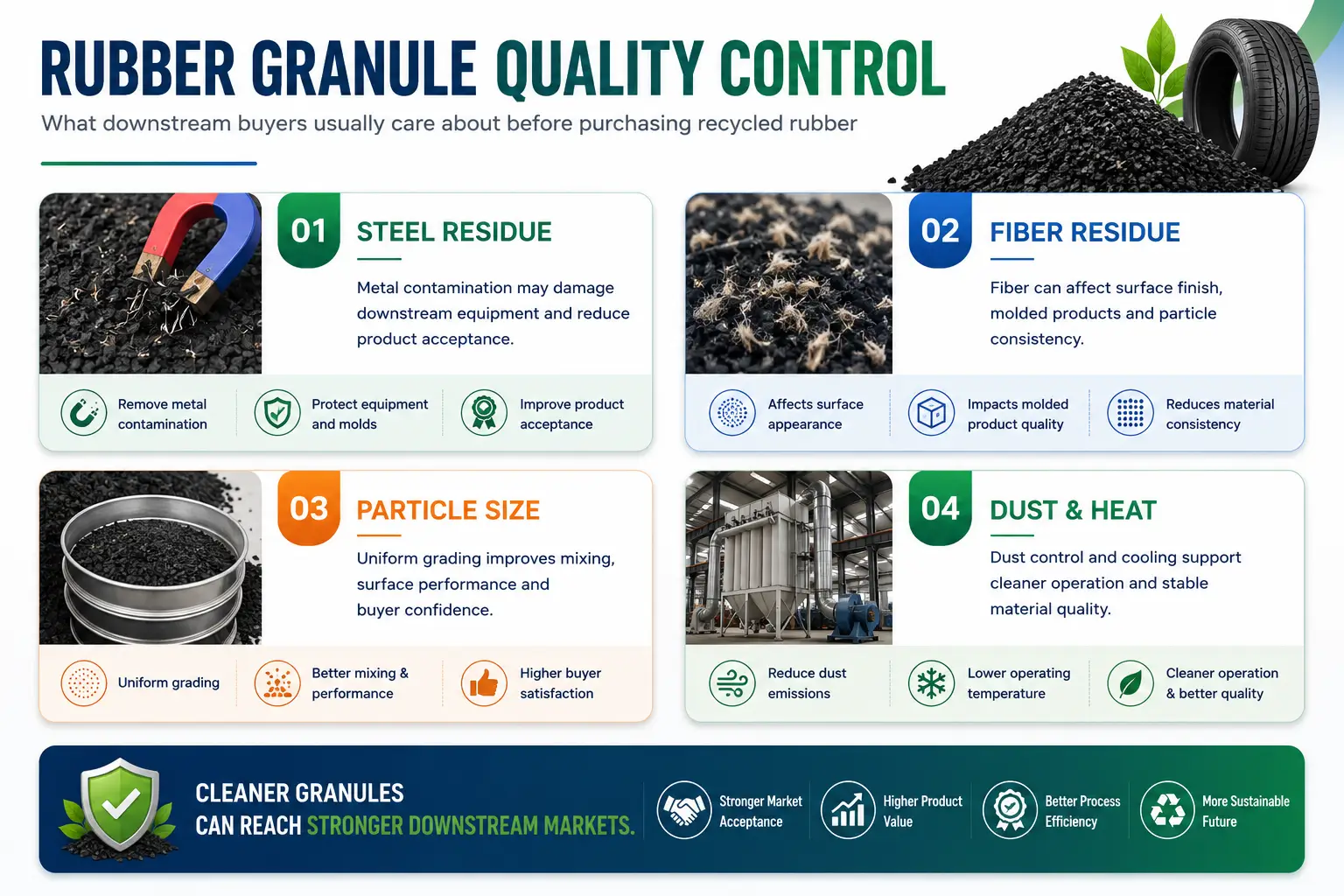
Material quality is where many recycling projects win or lose. A plant may produce a large volume of rubber, but if the material contains steel residue, fiber contamination, excessive dust or inconsistent particle size, downstream buyers may reject it or pay less attention to it.
| Quality factor | Why it matters |
| Steel contamination | Can damage downstream equipment and reduce product acceptance |
| Fiber residue | Can affect surface finish, rubber mixing and molded product quality |
| Particle consistency | Improves mixing, installation behavior and application stability |
| Dust control | Supports cleaner handling and better workshop conditions |
| Heat control | Helps reduce material degradation and production instability |
This is why a complete tire recycling line matters. Rubber granule quality is not created by one machine. It is created by the whole process: shredding, granulating, magnetic separation, fiber separation, screening and material handling.
6. Rubber granules production process
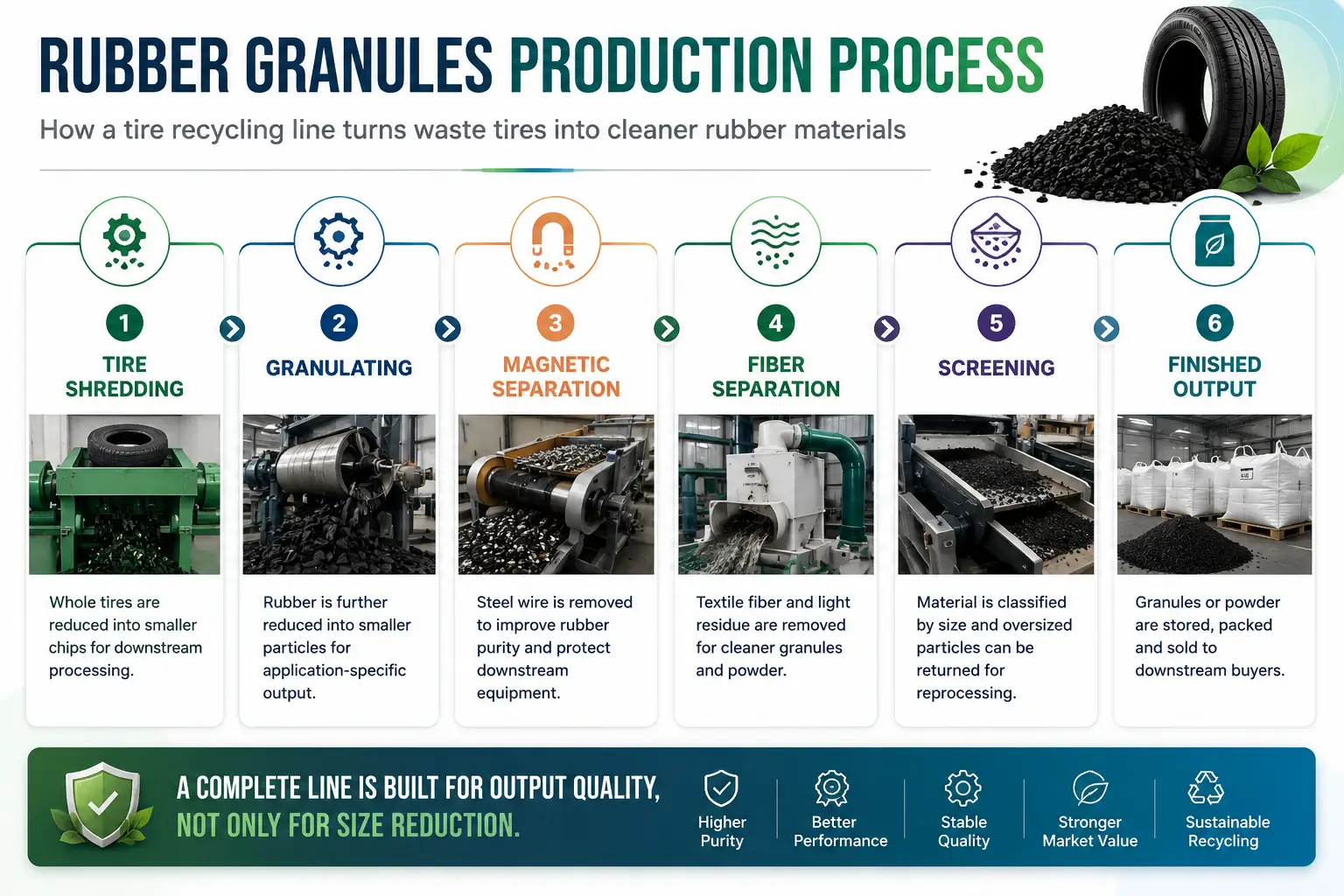
A typical recycled rubber granule process includes:
Waste tire sorting: separates passenger, truck or larger tires according to processing needs.
Primary shredding: reduces tires into smaller pieces suitable for downstream equipment.
Granulating: further reduces rubber pieces into granules.
Magnetic separation: removes steel wire from the rubber stream.
Fiber separation: removes textile fiber and light impurities.
Screening: classifies particles by size and returns oversized particles for reprocessing.
Storage and packaging: prepares finished rubber granules for downstream buyers.
The ShreddingTech Waste Tire Shredder Machine supports the front-end size reduction stage, while the Waste Tire Granulator supports particle reduction for recycled rubber production. For complete plant design, the Full-Automatic Waste Tire Recycling Line integrates multiple stages for rubber, steel and fiber separation.
7. Common problems in rubber granule production
Steel residue
If steel wire is not removed effectively, the rubber output may fail to meet downstream buyer requirements. Steel residue can also damage downstream processing or molding equipment.
Fiber residue
Textile fiber can reduce material consistency and may affect surface quality in molded products or sports surfaces. Fiber separation is especially important when producing cleaner granules or powder.
Uneven particle size
Uneven particle size can affect playground installation, artificial turf performance, rubber product molding and asphalt mixing. Screening and return systems help control this problem.
Dust generation
Dust affects workshop environment, worker comfort and material handling. A better line should consider dust collection and enclosed material transfer where needed.
Overheating
Rubber processing can generate heat. If heat is not controlled, it may affect material behavior and equipment stability. Proper process design helps reduce overheating risk.
8. How ShreddingTech equipment supports rubber granule quality
ShreddingTech should be positioned not only as a machine supplier, but as a tire recycling process partner. The reason is simple: the value of rubber granules depends on the whole production line, not only one machine.
The Waste Tire Recycling Line Plant is relevant because it is designed for automatic separation of rubber, steel wire and nylon fiber. This directly supports the quality needs of rubber granule markets. The Waste Tire Shredder Machine prepares the material for downstream granulation. The Waste Tire Granulator helps reduce rubber pieces into application-ready particles.
For buyers planning a recycled rubber business, the correct question is not only “which machine has the largest capacity?” The better question is “which line can produce the granule size and purity my downstream buyers need?”9. Future trends in recycled rubber applications
Recycled rubber applications are moving beyond basic waste disposal. Growing interest in sustainable construction, circular materials, rubber-modified asphalt, sports infrastructure and recycled industrial products is creating more opportunities for clean and consistent rubber granules.
Grand View Research notes that recycled rubber is increasingly used in higher-value applications such as asphalt modification, automotive components and sports surfaces, supported by improved processing technologies that enable finer and more purified rubber powders. Source: Grand View Research Tire Recycling Market Report
This trend is important for equipment buyers. As downstream applications become more demanding, recycling plants will need better separation, more consistent particle sizing and cleaner material output. This creates an opportunity for tire recycling companies that invest in process quality rather than only capacity.
10. FAQ
What are rubber granules used for?
Rubber granules are used for playground surfacing, sports flooring, artificial turf infill, rubber asphalt, molded rubber products, mats, tiles and some civil engineering applications.
What is the difference between rubber chips, rubber granules and crumb rubber?
Rubber chips are larger tire pieces, rubber granules are medium-sized particles used in surfaces and molded products, and crumb rubber or rubber powder is finer material used in asphalt, compounds and higher-value applications.
What size rubber granules are used for playgrounds?
Playground systems often use medium-sized rubber granules, but exact particle size depends on the surface system, binder and installation requirements. Consistency and cleanliness are more important than one universal size.
Are rubber granules environmentally friendly?
Rubber granules can support circular economy goals by reusing end-of-life tires and reducing waste. The environmental performance depends on application design, material quality and local regulations.
How are rubber granules made?
They are produced by shredding waste tires, reducing the rubber into smaller particles, removing steel wire, separating fiber and screening material into target particle sizes.
What affects rubber granule quality most?
The main factors are steel contamination, fiber residue, particle size consistency, dust control and the stability of the shredding and granulating process.
Can rubber granules be used in asphalt?
Yes. Fine crumb rubber can be used in rubber-modified asphalt when properly engineered and specified for road construction requirements.
Why is steel separation important?
Steel separation improves rubber purity, protects downstream equipment and supports higher acceptance in demanding applications such as molded products and sports surfaces.
Conclusion: rubber granules are a material business, not only a recycling output
Rubber granules are one of the most important downstream products in the waste tire recycling industry. Their value depends on particle size, cleanliness, separation quality and fit with downstream applications such as playgrounds, sports flooring, rubber asphalt, molded products and civil engineering materials.
For recycling companies, this means equipment should be selected according to the final application. A line designed only for size reduction may not produce material suitable for higher-quality markets. A complete tire recycling line with shredding, granulating, steel separation, fiber removal and screening can support cleaner and more consistent rubber granules.
Build a rubber granule production line around your target market
Recommended CTA: Tell ShreddingTech your waste tire type, target granule size, downstream application and required capacity. The engineering team can recommend a tire recycling line configuration based on your material and market goals.
Contact ShreddingTech / Yuxi for a project discussion

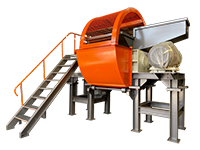 Shredding Machine
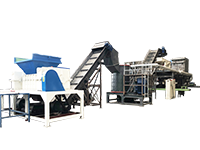 Waste Recycling Line
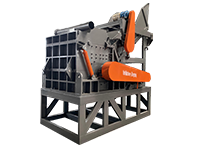 Optional Equipment